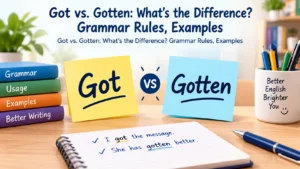
Have you ever paused while writing “I’ve got” or “I’ve gotten” and wondered which one is correct? You’re not alone. The difference between got vs. gotten confuses millions of English learners and even native speakers because both forms come from the same verb yet serve different purposes depending on where and how you use English.
The good news is that both words are correct. The right choice depends on the grammar, the meaning you want to express, and whether you’re writing in American English or British English.
This guide explains everything you need to know about got vs. gotten, including grammar rules, historical background, regional differences, examples, common mistakes, memory tricks, and a practice quiz.
Got vs. Gotten at a Glance
If you’re in a hurry, this table gives you the quick answer.
| Feature | Got | Gotten |
| Past tense of get | ✅ Yes | ❌ No |
| Past participle | British English | American English (mostly) |
| Used in American English | Yes | Yes |
| Used in British English | Yes | Rare |
| Indicates possession | Yes | Usually no |
| Indicates change or becoming | Sometimes | Yes |
Quick Rule
- Use got for the simple past.
- Use gotten as the past participle in most American English situations involving change, growth, or acquisition.
- Use got instead of gotten in most British English writing.
Understanding the Verb “Get”
Before comparing got and gotten, it helps to understand the verb get itself.
The verb get is one of the most flexible verbs in English. Depending on the sentence, it can mean:
- Receive something
- Become something
- Obtain something
- Arrive somewhere
- Understand something
- Buy something
- Experience something
Verb Forms
| Form | Word |
| Base verb | get |
| Present | get / gets |
| Present participle | getting |
| Past tense | got |
| Past participle | got (British English) / gotten (American English) |
Because get carries so many meanings, choosing the correct past participle becomes important.
What Does “Got” Mean?
Got is the simple past tense of get.
It describes something that happened in the past.
Examples
- I got your email yesterday.
- She got a promotion last month.
- They got home before sunset.
- We got tickets for the concert.
In these examples, got simply tells you what happened.
“Got” Also Shows Possession
English speakers often say:
- I’ve got a new laptop.
- We’ve got enough food.
- He’s got two sisters.
Here, have got means have.
This usage is common in both American and British English, although British English uses it even more frequently.
What Does “Gotten” Mean?
Gotten is the traditional past participle that American English has preserved.
It usually emphasizes that someone became, received, or acquired something.
Examples
- I’ve gotten much better at public speaking.
- She’s gotten taller over the past year.
- They’ve gotten several awards.
- The weather has gotten colder.
Notice that these examples focus on change over time rather than simple possession.
Got vs. Gotten: The Main Difference
Although both words come from get, they don’t always communicate the same idea.
| Meaning | Got | Gotten |
| Past action | ✅ | ❌ |
| Possession | ✅ | Rare |
| Becoming | Sometimes | ✅ |
| Receiving | Sometimes | ✅ |
| Change over time | Rare | ✅ |
Compare These Sentences
I’ve got a new phone.
This means I have a new phone.
I’ve gotten a new phone.
This means I received or bought a new phone recently.
The difference is subtle but important.
American English vs. British English
One of the biggest reasons people struggle with got vs. gotten is regional variation.
American English
Americans regularly use both forms.
Examples:
- I’ve gotten better.
- She’s gotten stronger.
- We’ve gotten permission.
- They’ve gotten married.
British English
British English usually prefers got.
Examples:
- I’ve got better.
- She’s got stronger.
- We’ve got permission.
- They’ve got married.
Both forms are grammatically correct within their respective varieties of English.
Why Did American English Keep “Gotten”?
Many people assume gotten is a modern American invention.
It isn’t.
In fact, gotten appeared in English centuries before the United States existed.
Historical Timeline
| Period | Development |
| Old English | Early forms of get appear. |
| Middle English | Gotten becomes a common past participle. |
| Early Modern English | Both got and gotten are widely used. |
| Later British English | Got gradually replaces gotten in most contexts. |
| American English | Gotten remains common and productive. |
In other words, Americans preserved an older English form while British usage evolved differently.
Grammar Rules You Should Know
Use “Got” for the Simple Past
Examples:
- She got the job.
- We got there early.
- They got lost.
- I got your message.
Use “Gotten” in American Present Perfect
Examples:
- I’ve gotten used to the weather.
- She’s gotten stronger.
- They’ve gotten more confident.
Use “Got” for Possession
Correct:
- I’ve got three brothers.
- She’s got plenty of experience.
- We’ve got enough time.
Not natural:
- I’ve gotten three brothers.
That sentence suggests your family somehow increased recently, which changes the meaning completely.
Common Expressions Using “Got”
Some expressions always use got, regardless of dialect.
Everyday Phrases
- I’ve got an idea.
- You’ve got mail.
- We’ve got to leave.
- Got it!
- You’ve got this.
- He’s got a point.
These expressions sound natural because they emphasize possession, obligation, or understanding rather than change.
Common Expressions Using “Gotten”
American English favors gotten in expressions involving progress or development.
Examples include:
- gotten better
- gotten worse
- gotten older
- gotten richer
- gotten faster
- gotten easier
- gotten stronger
- gotten colder
- gotten married
- gotten divorced
These expressions describe a transformation.
Real-Life Examples
Daily Conversation
- I’ve gotten really busy lately.
- She got home after work.
- We’ve got plenty of snacks.
Workplace
- The company has gotten larger.
- We got approval yesterday.
- She got promoted.
School
- Students have gotten better results this semester.
- He got an A in biology.
- We’ve gotten valuable feedback.
Travel
- We got to Chicago before noon.
- The roads have gotten much safer.
- They got their passports renewed.
Case Study: How One Word Changes Meaning
Imagine these two sentences.
Sentence One
“I’ve got a new car.”
Meaning:
You own a new car.
Sentence Two
“I’ve gotten a new car.”
Meaning:
You recently acquired one.
The first sentence focuses on possession.
The second emphasizes the process of obtaining it.
That small distinction explains why American English continues using gotten.
Read More: Me and My Family or My Family and I: Which Is Grammatically Correct?
Common Mistakes People Make
Even advanced learners make these errors.
Using “Gotten” in British Academic Writing
British publishers usually expect:
- I’ve got better.
Instead of:
- I’ve gotten better.
Confusing Past Tense and Present Perfect
Incorrect:
- Yesterday I have gotten home late.
Correct:
- Yesterday I got home late.
Using “Gotten” for Possession
Incorrect:
- I’ve gotten two children.
Correct:
- I’ve got two children.
Easy Memory Tricks
Here are a few simple ways to remember the difference.
Think About Change
If something changed, improved, grew, or developed, American English often uses gotten.
Example:
The weather has gotten warmer.
Think About Ownership
If someone simply has something, use got.
Example:
I’ve got your keys.
Remember the Formula
| Situation | Word |
| Happened yesterday | got |
| Have received | gotten |
| Have become | gotten |
| Have possession | got |
Common Alternatives to “Get”
Using get repeatedly can make your writing repetitive. Consider these stronger verbs when appropriate.
| Instead of Get | Try |
| get a job | obtain a job |
| get permission | receive permission |
| get stronger | become stronger |
| get information | gather information |
| get a prize | earn a prize |
| get food | buy food |
Choosing precise verbs often makes your writing clearer and more professional.
Quick Decision Tree
Did the action happen in the past?
│
Yes
│
Simple Past?
│
Yes
│
Use GOT
│
Present Perfect?
│
Yes
│
American English?
│
Yes
│
Use GOTTEN
Practice Quiz
Choose the correct word.
Questions
- I have ______ much better at cooking.
- She ______ home before midnight.
- We’ve ______ plenty of time.
- The weather has ______ colder.
- He ______ a new bicycle yesterday.
Answers
- gotten
- got
- got
- gotten
- got
FAQs:
Is “gotten” correct English?
Yes. Gotten is a standard and correct past participle in American English. It has existed for centuries and appears in formal writing, journalism, literature, and everyday conversation.
Why doesn’t British English use “gotten” very often?
Over time, British English simplified the past participle of get by favoring got. American English preserved gotten, especially when describing change or acquisition.
Can I use “got” instead of “gotten” in American English?
Sometimes. For possession, got is the natural choice. However, when describing change or something you acquired, gotten often sounds more precise.
Which form should English learners use?
If you’re learning American English, become comfortable using both got and gotten. If you’re learning British English, got will cover nearly all everyday situations.
Is “have got” the same as “have”?
In many cases, yes. For example, I’ve got a car and I have a car mean the same thing. However, have got is more common in casual conversation than in formal writing.
Conclusion:
The debate over got vs. gotten isn’t about one form being right and the other being wrong. Both are correct. The key is knowing when and where to use each one. Got works as the simple past tense of get and commonly expresses possession in both American and British English. Gotten, on the other hand, remains the preferred past participle in American English when talking about change, improvement, or acquiring something.
As a simple rule, use got for completed past actions and expressions like “I’ve got” to show possession. Choose gotten when you’re writing in American English and describing something that has become different or has been received over time. Paying attention to your audience also matters. If you’re writing for a British audience, got will usually sound more natural. If your readers are in the United States, gotten is widely accepted and often expected.
The more you read, write, and listen to native English speakers, the easier this distinction becomes. With the grammar rules, examples, and memory tips in this guide, you can confidently choose the correct form every time and make your writing clearer, more accurate, and more natural.