Have you ever paused while writing and wondered whether you should use “per cent” or “percent”? You’re not alone. This tiny spelling difference has puzzled students, professionals, editors, and even experienced writers for years.
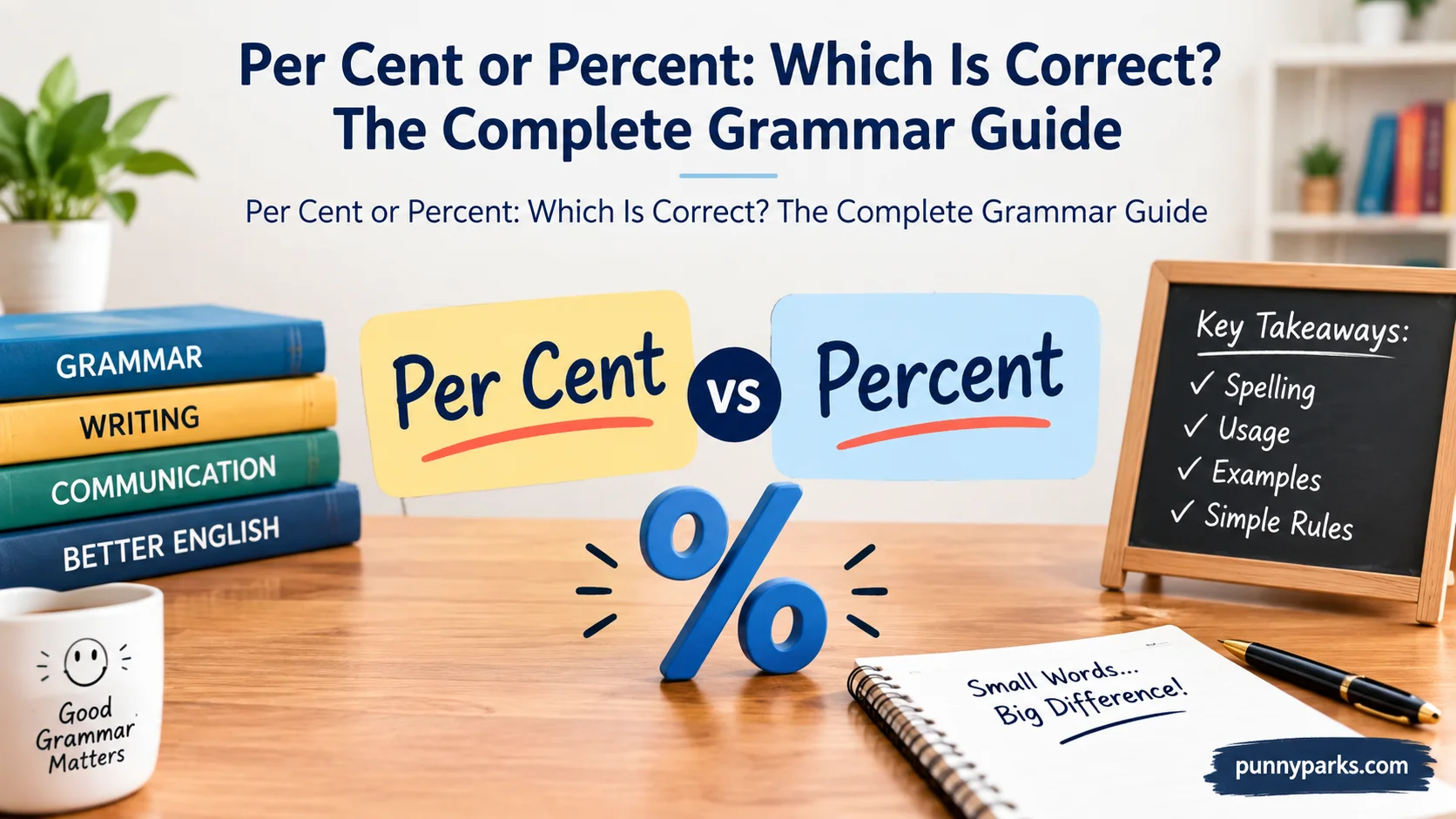
The good news is that both forms refer to the same mathematical concept: one part out of every hundred. The difference lies in modern spelling conventions, regional preferences, and style guide recommendations rather than meaning. Today, percent is the standard spelling in American English and has become increasingly common worldwide. Meanwhile, per cent still appears in some older British publications, historical documents, and traditional writing.
If you want your writing to look polished and up to date, understanding when to use each form matters. This guide explains the history behind both spellings, compares American and British usage, reviews major style guides, highlights common mistakes, and provides plenty of practical examples.
What Is the Difference Between “Per Cent” and “Percent”?
At first glance, per cent and percent appear to be different words. In reality, they have exactly the same meaning.
Both mean:
Out of every one hundred.
For example:
- 50 percent means 50 out of 100.
- Fifty per cent also means 50 out of 100.
The only real difference is how the term is written.
| Feature | Percent | Per Cent |
| Meaning | One part in one hundred | One part in one hundred |
| American English | Standard | Rare |
| Modern British English | Common | Less common |
| Historical British English | Less common | Traditional |
| Recommended today | Yes | Only in limited contexts |
Think of it like the words email and e-mail. They once competed as acceptable spellings, but one gradually became the preferred standard.
Today, percent has largely won that race.
The Short Answer
If you’re writing for a modern audience, here’s the simple rule.
Use “percent.”
That’s the spelling preferred in:
- American English
- Most Canadian publications
- Modern Australian writing
- Business documents
- Academic papers
- Online articles
- Government publications
- Marketing content
Use per cent only when:
- Quoting older documents
- Preserving historical spelling
- Following a publisher’s house style
- Writing about historical texts
For almost every everyday situation, percent is the safest and most professional choice.
Why “Per Cent” Became “Percent”
Language constantly evolves. Words become shorter, spellings become simpler, and everyday usage shapes dictionaries.
The story of percent is a perfect example.
The expression comes from the Latin phrase:
per centum
which literally means:
by the hundred
English writers originally borrowed this phrase almost unchanged.
Over time, it appeared in several forms:
- per centum
- per cent.
- per cent
- percent
Eventually, English speakers began treating it as a single word rather than two separate words.
This change followed a familiar pattern in English.
Consider these examples.
| Older Form | Modern Form |
| To day | Today |
| Any one | Anyone |
| Every one | Everyone |
| Good bye | Goodbye |
| Per cent | Percent |
Combining frequently used expressions into one word makes reading smoother and writing more efficient.
That’s exactly what happened with percent.
A Brief Timeline of the Word
Understanding the history helps explain why both spellings still exist.
| Time Period | Preferred Form |
| 1500s–1700s | Per centum |
| 1700s–1800s | Per cent |
| Early 1900s | Both forms common |
| Mid-1900s | Percent gains popularity |
| Today | Percent dominates |
The shift didn’t happen overnight. Newspapers, publishers, and educators gradually adopted percent because it matched modern spelling trends.
Today, most dictionaries list percent as the primary spelling.
Percent vs. Per Cent in American and British English
Regional differences explain much of the confusion.
Although American English strongly favors percent, British English historically accepted both versions.
Here’s a simple comparison.
| Region | Preferred Spelling |
| United States | Percent |
| Canada | Percent |
| Australia | Percent |
| New Zealand | Percent |
| Modern United Kingdom | Percent (most publications) |
| Older UK publications | Per cent |
Many older British newspapers printed per cent for decades.
Modern publishers, however, increasingly use percent because it aligns with contemporary dictionaries and digital style standards.
This means British readers are now much more likely to encounter percent than they were twenty years ago.
Why American English Chose “Percent”
American English generally favors simplified spellings.
Other examples include:
| British Variant | American Variant |
| Colour | Color |
| Honour | Honor |
| Traveller | Traveler |
| Programme | Program |
| Per cent | Percent |
The goal isn’t to change meaning.
Instead, simplified spelling improves consistency and readability.
That’s one reason American style guides overwhelmingly recommend percent.
Read More: Got vs. Gotten: What’s the Difference? Grammar Rules, Examples
Which Style Guides Recommend “Percent”?
Professional writers rarely rely on personal preference.
Instead, they follow established style guides.
Fortunately, the major guides agree.
| Style Guide | Recommendation |
| AP Style | Percent |
| Chicago Manual of Style | Percent |
| APA Style | Percent |
| MLA Style | Percent in prose |
| Government writing guides | Percent |
AP Style
Associated Press style recommends writing:
- 25%
- 25 percent
depending on context.
Modern AP Style commonly allows the percent sign with numerals in news writing, reflecting current editorial practice.
Chicago Manual of Style
Chicago generally spells out percent in running text unless the context requires symbols, such as tables or scientific material.
APA Style
APA often uses the % symbol when paired with numerals in research papers.
For example:
- 35%
rather than:
- thirty-five percent
Scientific writing values efficiency and consistency.
MLA Style
MLA generally spells out percent in prose unless your instructor or publisher specifies otherwise.
Across these guides, one pattern is clear.
Percent is the accepted spelling.
When Should You Use “Percent”?
Most writers will use percent in nearly every type of document.
Examples include:
Business Writing
Companies regularly report:
- sales growth
- market share
- customer satisfaction
- profit margins
Example:
Revenue increased by 18 percent during the fourth quarter.
Academic Writing
Students frequently discuss:
- survey results
- research findings
- statistics
- experiments
Example:
Nearly 72 percent of participants completed the questionnaire.
Journalism
News articles constantly reference percentages.
Examples include:
- election polls
- unemployment
- inflation
- sports statistics
Example:
Nearly 60 percent of voters supported the proposal.
Marketing
Marketing teams use percentages to demonstrate value.
Examples:
- 40 percent discount
- 95 percent customer satisfaction
- 87 percent recommendation rate
Readers quickly understand these figures, making percentages powerful communication tools.
Why Percentages Matter in Everyday Life
Many people associate percentages only with math class.
In reality, they influence decisions every day.
You encounter percentages when:
- shopping during sales
- comparing mortgage rates
- checking weather forecasts
- reading nutrition labels
- reviewing investment returns
- evaluating test scores
- tracking business performance
- interpreting medical studies
Understanding how percentages work helps you make smarter financial and practical decisions.
For example, a store advertising 50 percent off sounds impressive. However, if the original price was inflated, the actual savings may be less meaningful than they appear. That’s why informed consumers look beyond the percentage and consider the final price.
Case Study: Why One Word Matters
Imagine two companies publishing annual reports.
Company A uses percent consistently throughout its report.
Company B switches between percent, per cent, and the % symbol without any pattern.
Although the data may be identical, Company A appears more professional because its writing is consistent. Editors, investors, and readers often judge credibility based on these small details.
Consistency builds trust. That simple principle explains why organizations adopt style guides and stick to them throughout every document.
“Good writing isn’t just about choosing the right words. It’s also about choosing them consistently.”
Is “Per Cent” Ever Wrong?
Not necessarily. “Per cent” isn’t incorrect, but it has become uncommon in modern English. Whether you should use it depends on your audience, the type of document you’re writing, and any style guide you need to follow.
For most readers, percent looks more familiar and contemporary. Using per cent in everyday writing may seem old-fashioned, even though the meaning remains identical.
Here are a few situations where per cent still makes sense:
- You’re quoting a historical document exactly as it appears.
- You’re reproducing text from an older British publication.
- A publisher or organization specifically requires that spelling.
- You’re discussing the history of the English language.
For example:
Original historical text: “The tax shall be increased by five per cent.”
If you’re quoting that sentence, preserve the original spelling. Changing it to percent could alter the authenticity of the quotation.
Outside those situations, percent is almost always the better choice.
Percent vs. Percentage
Many writers confuse percent and percentage, but they serve different purposes.
A percent expresses an exact numerical value out of one hundred.
A percentage refers to a proportion or rate without necessarily giving a precise number.
| Percent | Percentage |
| Exact value | General proportion |
| Includes a number | May not include a number |
| “25 percent” | “A high percentage” |
| Mathematical measurement | General description |
Examples
Correct:
- Thirty percent of the employees work remotely.
- Only 5 percent of the budget remains.
- Eighty-five percent of customers renewed their subscriptions.
Correct:
- A large percentage of travelers booked online.
- Only a small percentage of students missed class.
- An increasing percentage of shoppers prefer contactless payments.
Incorrect:
- A large percent of travelers…
- The percentage was 25 percentage.
The easiest way to remember the difference is this:
- Percent = exact number.
- Percentage = general amount.
Percent vs. Percentage Point
This distinction often causes confusion in business, economics, politics, and finance.
Suppose unemployment rises from 4 percent to 6 percent.
Many people say it increased by 2 percent, but that’s inaccurate.
It actually increased by 2 percentage points.
Here’s why.
| Situation | Correct Description |
| 4% → 6% | Increase of 2 percentage points |
| 4% → 6% | Increase of 50 percent relative to the original value |
The phrase percentage point describes the arithmetic difference between two percentages.
This distinction matters in:
- Election polling
- Interest rates
- Inflation
- Stock market reports
- Economic research
Professional writers make this distinction because it prevents misunderstandings.
Should You Write “%” or “Percent”?
Another common question is whether to spell out the word or use the % symbol.
Both are correct, but each works best in different situations.
| Use “%” | Use “percent” |
| Tables | Essays |
| Charts | Blog posts |
| Scientific papers | Business letters |
| Statistics | General writing |
| Financial reports | Books |
Examples
Using the symbol
- Sales increased by 18%.
- Only 4% of participants withdrew.
Using the word
- Sales increased by 18 percent this year.
- About 4 percent of participants withdrew.
Which Looks More Professional?
It depends on the context.
Academic journals, spreadsheets, and research papers often favor the % symbol because it saves space and improves readability.
Articles, books, blogs, and general business writing usually read more smoothly when you spell out percent, unless you’re following a specific style guide.
The key is consistency. Don’t alternate between 25% and 25 percent without a reason.
Common Mistakes Writers Make
Even experienced writers occasionally misuse percent. Fortunately, these mistakes are easy to avoid.
Mixing Spellings
Incorrect:
- Sales rose by 12 percent in January and 15 per cent in February.
Correct:
- Sales rose by 12 percent in January and 15 percent in February.
Choose one style and stick with it.
Using “Percent” Without a Number
Incorrect:
- A high percent of customers returned.
Correct:
- A high percentage of customers returned.
Remember, percent needs a specific number.
Forgetting “Of”
Incorrect:
- Fifty percent employees participated.
Correct:
- Fifty percent of employees participated.
The phrase percent of is almost always required.
Confusing Percentage Points
Incorrect:
- Inflation increased by 2 percent.
Correct:
- Inflation increased by 2 percentage points.
Small wording differences can completely change the meaning.
Inconsistent Formatting
Avoid switching between styles like this:
- 20%
- twenty percent
- 35 %
- thirty-five per cent
Instead, follow one style throughout your document.
Quick Grammar Quiz
Test your understanding before moving on.
Question 1
Which spelling is preferred in modern American English?
- A. Per cent
- B. Percent
Answer: B. Percent
Question 2
Which sentence is correct?
- A. A large percent of voters agreed.
- B. A large percentage of voters agreed.
Answer: B
Question 3
Which sentence is correct?
- A. Fifty percent employees attended.
- B. Fifty percent of employees attended.
Answer: B
Question 4
A company’s profit rises from 12% to 15%.
What is the correct description?
Answer:
- An increase of 3 percentage points.
- A 25 percent increase relative to the original value.
Percent or Per Cent Cheat Sheet
| Situation | Best Choice |
| American English | Percent |
| Modern business writing | Percent |
| Blog articles | Percent |
| School essays | Percent |
| Historical quotations | Per cent |
| Older British publications | Per cent |
| Exact numerical value | Percent |
| General proportion | Percentage |
| Scientific tables | % |
| Running text | Percent |
FAQs:
Is “per cent” still used today?
Yes, but mostly in historical texts, archived British publications, or when preserving original spelling. Modern writing overwhelmingly favors percent.
Which spelling should students use?
Students should almost always write percent unless a teacher or style guide instructs otherwise.
Do dictionaries accept both spellings?
Yes. Most major dictionaries recognize both forms, although percent appears as the preferred modern spelling.
Should I write “50%” or “50 percent”?
Either is correct. Use 50% in tables, charts, scientific writing, and technical documents. Use 50 percent in most general prose unless a style guide says otherwise.
Is “percentage” the same as “percent”?
No. Percent refers to a specific value out of one hundred, while percentage describes a general proportion and doesn’t always include an exact number.
Conclusion:
If your goal is clear, professional, and modern writing, the answer is simple: use “percent.”
While per cent has a rich history and still appears in older British texts, it no longer represents the standard choice for most readers. Major style guides, dictionaries, educators, and publishers overwhelmingly recommend percent because it reflects contemporary English usage.
Keep these key points in mind:
- Percent is the standard spelling in modern American English and is widely accepted internationally.
- Per cent isn’t wrong, but it now appears mainly in historical or stylistic contexts.
- Use percentage when referring to a general proportion rather than an exact figure.
- Distinguish percentage points from percent when comparing percentages.
- Choose either % or percent based on your style guide and document type, then use that format consistently.
Small grammar choices can make a big difference. By choosing the right spelling and applying it consistently, you’ll produce writing that looks polished, credible, and easy to read. Whether you’re drafting a report, publishing a blog post, completing an assignment, or preparing business documents, using percent will help your writing match modern English standards and meet your readers’ expectations.