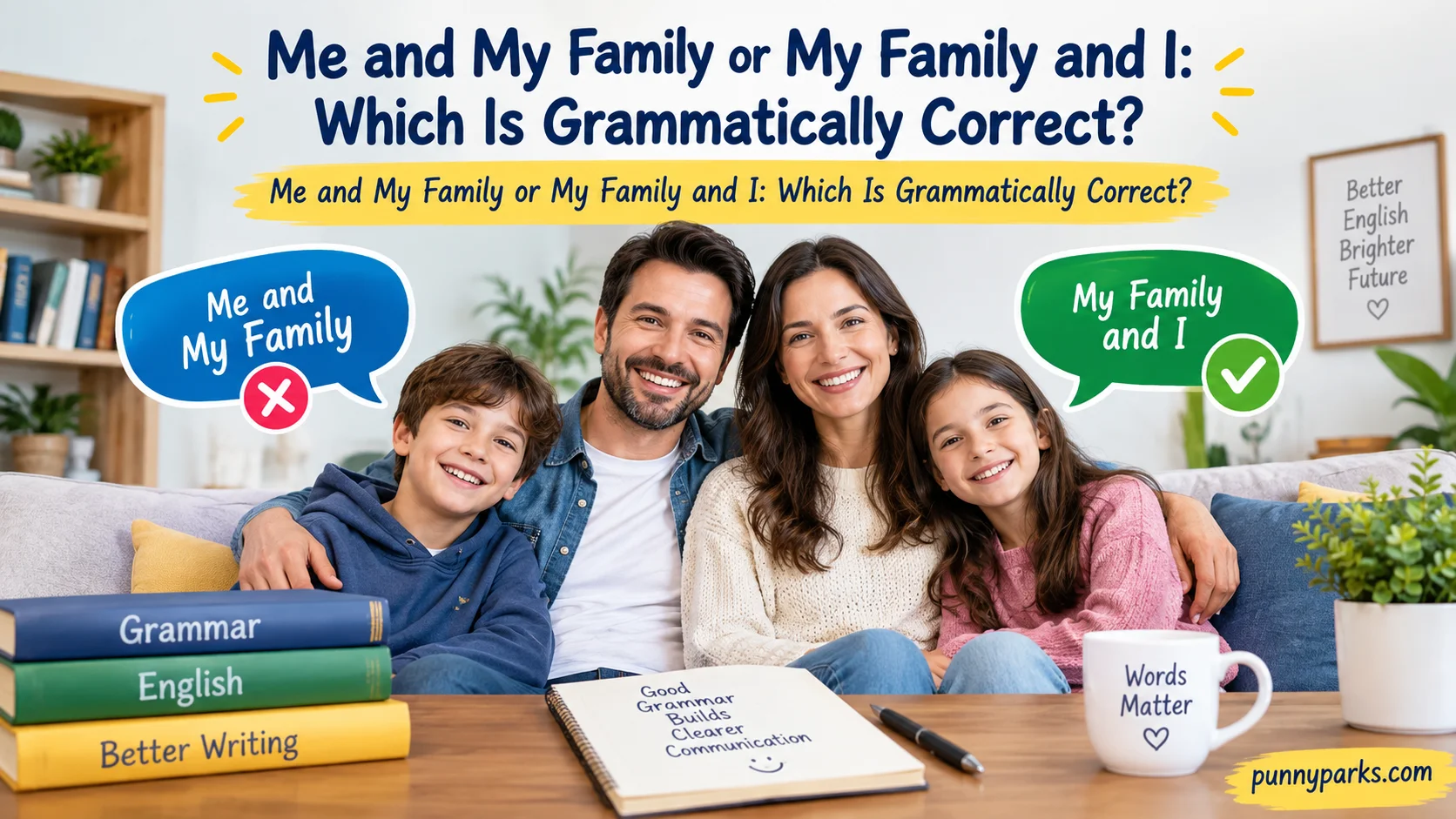
Me and My Family or My Family and I: Which Is Grammatically Correct? helps English learners choose the right pronoun in each sentence with care.
Me and My Family and My Family and I can seem confusing, especially in everyday English, informal conversation, and spoken English. The key is to identify the subject role and object role of the pronoun. When the group performs an action, My Family and I is normally the correct subject pronoun, as in My family and I went to the movies. When the group receives an action, my family and me is the correct object form. A useful pronoun selection trick is to remove “and my family” and test the sentence. If I works, choose My Family and I; if me works, use the object form.
This approach makes sentence structure, sentence formation, phrase structure, and grammatical correctness easier for English learners, language learners, and students. In real-world usage, Me and John went shopping and Me and my family love traveling may sound natural because native speakers often use these expressions while talking. However, formal writing, formal speech, formal English writing, professional writing, emails, essays, blog posts, school assignments, captions, and professional documents require greater clarity, correctness, professionalism, and grammatical accuracy. Understanding spoken habits, cultural habits, social norms, social expectations, tone, and politeness helps learners understand why usage changes across different contexts. With reading, writing, and speaking, learners can improve language awareness, confidence-building, English skills, and correct usage without overthinking, hesitation, or second-guessing.
Me and My Family or My Family and I: The Quick Answer
If you’re in a hurry, here’s the rule you need.
| Sentence Position | Correct Phrase | Example |
| Subject (before the verb) | My family and I | My family and I visited New York. |
| Object (after the verb) | My family and me | The teacher congratulated my family and me. |
Quick Memory Rule
Remove “my family” from the sentence.
For example:
My family and I went shopping.
Now remove “my family.”
I went shopping. ✅
That sounds correct.
Now try this:
Me went shopping. ❌
Since “me” doesn’t work alone, “me and my family” isn’t correct in this sentence.
This simple test works almost every time.
Why Do People Get Confused?
English has different pronouns for different jobs in a sentence. Unfortunately, everyday speech often ignores those rules.
Many people grow up hearing phrases like:
- Me and my brother
- Me and my friends
- Me and my parents
- Me and my family
Because these expressions are common, they begin to sound correct.
However, written English follows stricter grammar rules than casual conversation.
Think about driving. People often exceed the speed limit. That doesn’t make speeding the official rule. Spoken English works much the same way.
Understanding Subject and Object Pronouns
Before learning the grammar rule, it’s helpful to understand two basic terms.
Subject Pronouns
A subject performs the action.
Subject pronouns include:
| Singular | Plural |
| I | We |
| You | You |
| He | They |
| She | They |
| It | They |
Examples:
- I love hiking.
- She plays soccer.
- We enjoy traveling.
Notice that these pronouns perform the action.
Object Pronouns
An object receives the action.
Object pronouns include:
| Singular | Plural |
| Me | Us |
| You | You |
| Him | Them |
| Her | Them |
| It | Them |
Examples:
- Sarah invited me.
- The coach praised us.
- Everyone welcomed them.
The object receives the action rather than performing it.
The Golden Grammar Rule
Here’s the rule that solves almost every question.
Use “I” when you’re doing the action. Use “me” when the action happens to you.
That means:
✔ My family and I visited the museum.
Your family and you performed the action.
✔ The guide welcomed my family and me.
The guide performed the action. You received it.
Although the rule sounds simple, many people overlook it during conversation.
The “Remove the Other Person” Trick
Teachers have recommended this shortcut for decades because it works so well.
Whenever you’re unsure, remove the other people from the sentence.
Example One
My family and I are planning a vacation.
Remove my family.
I am planning a vacation.
That sounds correct.
Example Two
The neighbors invited my family and me.
Remove my family.
The neighbors invited me.
That also sounds correct.
Example Three
Me and my family are excited.
Remove my family.
Me am excited.
That clearly sounds wrong.
The correct sentence becomes:
My family and I are excited.
When “My Family and I” Is Correct
Use this phrase whenever it comes before the verb and acts as the subject.
Examples:
- My family and I love camping.
- My family and I traveled across California.
- My family and I attend church every Sunday.
- My family and I enjoy movie nights.
- My family and I adopted a puppy.
Notice something interesting.
Every sentence begins with the people performing the action.
That makes “I” the correct pronoun.
Common Situations
You’ll often use my family and I in:
- School essays
- Business presentations
- College applications
- Job interviews
- Speeches
- News articles
- Professional emails
These situations require standard grammar.
When “My Family and Me” Is Correct
Many learners think “my family and me” is always wrong.
It isn’t.
In fact, it’s the correct choice after verbs and prepositions.
Examples:
- Everyone welcomed my family and me.
- The photographer took a picture of my family and me.
- The award was presented to my family and me.
- The invitation included my family and me.
- They sat beside my family and me.
Each sentence places your family after the action.
That’s why me is correct.
Is “Me and My Family” Ever Correct?
This question surprises many readers.
From a grammar perspective, “me and my family” is generally not correct when it functions as the subject.
However, language isn’t always black and white.
You’ll hear it frequently in:
- Casual conversations
- Song lyrics
- Movies
- Television shows
- Social media posts
- Regional dialects
For example:
Me and my family are going fishing.
Most native speakers understand the meaning immediately.
In everyday conversation, very few people will stop to correct you.
Still, formal writing follows different standards.
If you’re writing an essay, professional email, academic paper, or business report, choose “my family and I.”
Read More: Spiritual Meaning of Roly Poly Bugs: Inner Strength
Why Does English Put Yourself Last?
English also follows a rule of courtesy.
When mentioning yourself with other people, place yourself last.
Instead of saying:
- I and my family
- Me and my parents
English normally prefers:
- My family and I
- My parents and I
- My friends and I
This word order sounds more polite because it places the other people before yourself.
Although it isn’t an absolute grammar rule, it has become standard English etiquette.
Formal English vs. Everyday Conversation
One reason learners become confused is that spoken English and written English often differ.
| Formal English | Casual Speech |
| My family and I went shopping. | Me and my family went shopping. |
| My parents and I attended the concert. | Me and my parents went. |
| My brother and I play basketball. | Me and my brother play basketball. |
Neither version prevents communication.
The difference lies in context.
Use formal grammar whenever accuracy matters. Reserve informal expressions for relaxed conversations with friends or family.
Common Mistakes People Make
Many similar grammar mistakes follow the same pattern.
| Incorrect | Correct |
| Me and John went home. | John and I went home. |
| Me and my sister baked cookies. | My sister and I baked cookies. |
| Him and I finished first. | He and I finished first. |
| Her and me studied together. | She and I studied together. |
| Between you and I | Between you and me |
A useful observation emerges here.
Whenever you’re unsure, test the pronoun by itself. If it sounds wrong alone, it will also sound wrong with another person.
Real-Life Examples of “My Family and I” vs. “My Family and Me”
Grammar rules become much easier when you see them in everyday situations. Instead of memorizing definitions, notice how these phrases naturally fit into real conversations.
At Home
Correct
- My family and I cooked dinner together.
- My family and I watched a movie last night.
- My family and I decorated the house for Christmas.
- My family and I planted flowers in our backyard.
Correct (Object Form)
- Grandma invited my family and me for dinner.
- The neighbors surprised my family and me with homemade cookies.
- Our relatives visited my family and me during the holidays.
At School
Students often need these phrases in essays and classroom discussions.
Examples:
- My family and I recently moved to a new city.
- My family and I volunteer at community events.
- The principal welcomed my family and me on the first day.
- The teacher congratulated my family and me after the science fair.
At Work
Professional writing should always follow standard grammar.
Examples:
- My family and I appreciate your support.
- My family and I recently relocated for my new position.
- The company invited my family and me to the annual celebration.
- The manager thanked my family and me for attending.
While Traveling
Travel stories provide another excellent example.
Examples:
- My family and I visited Yellowstone National Park.
- My family and I explored the Grand Canyon during summer vacation.
- The tour guide welcomed my family and me.
- The airline upgraded seats for my family and me.
On Social Media
Social media tends to be more relaxed.
You might see captions like:
- Me and my family at Disney! 📸
- Me and my family having the best weekend ever!
These captions are common, but formal grammar would change them to:
- My family and I are at Disney.
- My family and I had an amazing weekend.
Neither version changes the meaning. The difference is simply the level of formality.
Sentence Breakdown: Understanding Why It Works
Let’s look inside a sentence.
Example 1
My family and I visited Chicago.
| Part | Function |
| My family and I | Subject |
| Visited | Verb |
| Chicago | Object |
Because my family and I performs the action, I is correct.
Example 2
The guide welcomed my family and me.
| Part | Function |
| The guide | Subject |
| Welcomed | Verb |
| My family and me | Object |
Since your family receives the action, me is correct.
Formal Writing vs. Spoken English
One of the biggest differences in English comes from context.
Formal English values grammatical precision.
Informal English values natural conversation.
Here’s a comparison.
| Situation | Recommended Form |
| Academic essays | My family and I |
| Business emails | My family and I |
| Job interviews | My family and I |
| News articles | My family and I |
| Casual conversation | Either, though “my family and I” is grammatically correct |
| Text messages | Either |
| Social media captions | Either, depending on tone |
When in doubt, choose “my family and I.” It works in every formal situation and never sounds inappropriate.
Does American English Differ from British English?
Many learners wonder whether American English and British English follow different grammar rules.
The answer is no.
Both varieties follow the same grammatical distinction between I and me.
However, informal speech differs slightly.
In both the United States and the United Kingdom, you’ll often hear native speakers say:
- Me and my mates…
- Me and my family…
- Me and my friends…
These expressions appear frequently in conversation because spoken language evolves naturally.
Formal writing, however, still follows the traditional grammar rule.
Common Pronoun Mistakes Related to This Topic
Once you understand I versus me, many other confusing expressions become easier.
My Friend and I vs. My Friend and Me
Correct:
- My friend and I went hiking.
- The coach congratulated my friend and me.
John and I vs. John and Me
Correct:
- John and I work together.
- The manager called John and me.
Between You and Me
Many people mistakenly say:
❌ Between you and I
The correct expression is:
✅ Between you and me
Why?
Because between is a preposition, and prepositions require object pronouns.
He and I vs. Him and Me
Correct:
- He and I play tennis every weekend.
- The referee congratulated him and me.
Again, notice the pattern.
Subjects use I.
Objects use me.
Memory Tricks You’ll Never Forget
Grammar becomes much easier when you have a simple shortcut.
Trick One: Remove the Other Person
Sentence:
My family and I are leaving tomorrow.
Remove “my family.”
I am leaving tomorrow.
Correct.
Sentence:
The neighbors invited my family and me.
Remove “my family.”
The neighbors invited me.
Correct.
Trick Two: Look Before the Verb
Ask yourself one question.
Is the phrase performing the action?
If yes:
Use I.
If not:
Use me.
Trick Three: Listen for What Sounds Natural Alone
Compare these.
I went home.
Me went home.
Only one sounds natural.
That answer tells you which pronoun belongs in the full sentence.
Practice Quiz
Test your understanding before moving on.
Question 1
___ are planning a camping trip.
A. Me and my family
B. My family and I
Answer: B
Question 2
The teacher praised ___ after the competition.
A. My family and I
B. My family and me
Answer: B
Question 3
___ enjoy cooking together.
A. My family and I
B. Me and my family
Answer: A
Question 4
The photographer took pictures of ___.
A. My family and me
B. My family and I
Answer: A
Question 5
The neighbors thanked ___ for helping.
A. My family and me
B. My family and I
Answer: A
Quick Cheat Sheet
| If the phrase… | Use |
| Performs the action | My family and I |
| Receives the action | My family and me |
| Comes before the verb | I |
| Comes after a verb or preposition | Me |
| Is part of formal writing | My family and I (when it’s the subject) |
| Is casual conversation | Either may appear, but grammar rules still favor the correct form |
FAQs:
Is “Me and My Family” grammatically correct?
In informal speech, Me and My Family is common, but My Family and I is preferred when the phrase is the subject.
Is “My Family and I” correct?
Yes. Use My Family and I when you and your family perform the action, such as “My family and I traveled.”
When should I use “my family and me”?
Use my family and me when the phrase acts as the object, such as “They invited my family and me.”
Is “Me and My Family” wrong?
Not always. It’s common in casual conversation, but it’s usually avoided in formal writing.
How can I choose between “I” and “me”?
Remove “and my family” from the sentence. If I sounds correct, use My Family and I; if me works, use my family and me.
Conclusion:
Choosing between Me and My Family and My Family and I becomes easier when you identify whether the pronoun is the subject or object. Use My Family and I when performing an action and my family and me when receiving an action. Although Me and My Family is common in informal speech, careful writers should use the form that fits the sentence and context.Master this one rule, and you’ll avoid one of the most common grammar mistakes in English while making your writing sound polished, professional, and clear.