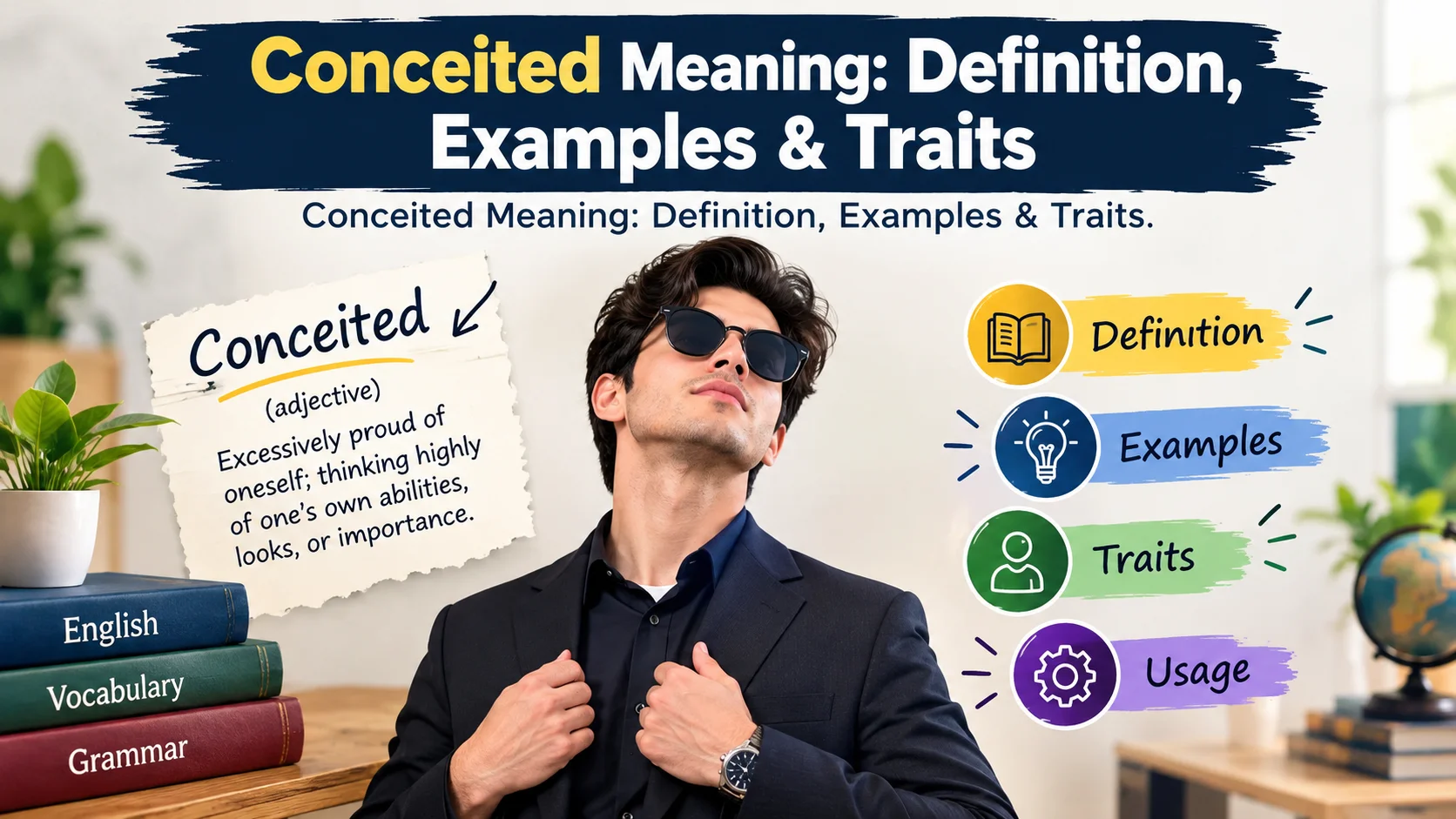
Learn the conceited meaning, its history, common examples, differences from confidence and arrogance, and how the word is used today.
The conceited meaning describes someone who has too much pride in themselves, their abilities, or their achievements. The word usually has a negative tone because it suggests that a person thinks too highly of themselves. A conceited person may believe they are better, smarter, or more talented than other people. This attitude can make them appear arrogant, selfish, or overly confident in different situations. The term is often used to describe someone who focuses heavily on themselves.
In everyday American English, calling someone conceited often means they seem overly impressed with themselves. For example, a person may constantly talk about their looks, success, intelligence, or talents. They might also expect constant praise and attention from people around them. However, feeling proud of an accomplishment does not automatically make someone conceited or arrogant. Healthy pride can show confidence and self-respect, while conceit usually goes much further.
The key difference is whether personal pride becomes excessive or unreasonable. Someone may be proud of their achievements while still showing respect and appreciation for other people. A conceited person, however, may act as though they are superior to others and may dislike criticism. They can also have difficulty accepting mistakes, advice, or different opinions. Understanding this distinction makes it easier to recognize conceited behavior in everyday life.
Quick Answer
Conceited meaning refers to being overly proud of yourself, your actions, or your abilities. In the United States, it usually suggests excessive self-confidence combined with an attitude of superiority
TL;DR
• Conceited means excessively proud of yourself or your abilities.
• The word usually has a negative or disapproving tone.
• Confidence and conceit aren’t the same thing.
• The word developed from older meanings involving thoughts and ideas.
• American English commonly connects conceit with self-importance.
• Modern usage often focuses on attitude rather than achievement.
What Does Conceited Mean?
The simplest definition is too proud of yourself and what you do. Oxford gives essentially this meaning and labels the word as disapproving.
Cambridge similarly defines it as being too proud of yourself, your actions, and your abilities. It also connects the word with attitudes such as arrogance, haughtiness, and self-importance.
The Basic Idea
Someone may be called conceited when they regularly believe they’re better than others.
For example, imagine someone who constantly talks about being the smartest person in the room. They might also dismiss other people’s ideas and expect special attention. That behavior can come across as conceited.
The word focuses on excess, not ordinary self-respect.
What Conceited Doesn’t Automatically Mean
Being happy about your success doesn’t make you conceited.
Likewise, enjoying your appearance, celebrating an achievement, or speaking confidently can be perfectly healthy. The concern appears when pride becomes exaggerated or dismissive toward other people.
Read More: Pretentious Meaning: Definition, Examples, and Usage
What Is the Origin of Conceited?
The history of conceited goes back several centuries. Its earlier forms were connected to the idea of something being conceived or formed in the mind.
The noun conceit appeared in English during the late Middle English period. Its meaning developed from “a thought” or “notion” toward a fanciful or clever idea.
From Thought to Self-Pride
By around the early 1600s, conceit had developed a meaning involving vanity and an exaggerated opinion of one’s own abilities. The adjective conceited took on its modern sense around the same period.
This shift is especially interesting because the word didn’t begin as an insult.
Earlier uses could describe intelligence, cleverness, or an ingenious thought. Over time, however, the self-focused meaning became much more prominent.
Two Meanings of Conceit
Even today, conceit has another literary meaning.
It can describe a clever or surprising comparison in poetry or writing. Oxford and Cambridge both recognize this separate literary sense.
So context matters. A “literary conceit” isn’t describing an arrogant person.
Conceited vs. Confident
People often confuse conceited with confident. However, these words describe different attitudes.
Confidence generally means trusting your abilities without needing to place yourself above everyone else. Conceit suggests that self-belief has gone too far.
A Simple Comparison
| Context | Confident | Conceited | Common Signal |
| Work | “I can handle this project.” | “Nobody could do this better.” | Self-belief vs. superiority |
| Appearance | “I like how I look.” | “Everyone looks worse than me.” | Self-acceptance vs. comparison |
| Skills | “I’m good at this.” | “I’m obviously the best.” | Ability vs. exaggeration |
| Conversation | Shares achievements naturally | Constantly boasts | Pride vs. self-focus |
| Feedback | Accepts useful criticism | Rejects criticism | Openness vs. defensiveness |
Why the Difference Matters
Confidence can help people take healthy risks and communicate clearly.
However, conceit can damage relationships because it may make other people feel ignored or belittled. The difference often appears in how someone treats people around them.
What Are the Signs of a Conceited Person?
A single boastful comment doesn’t necessarily make someone conceited. Instead, the label usually describes a repeated pattern of behavior.
Common Signs
• Frequently talks about personal achievements
• Assumes their opinions are automatically better
• Struggles to accept criticism from others
• Expects admiration or special treatment
• Often compares themselves favorably with others
• Dismisses accomplishments that don’t involve them
The Cambridge Dictionary also connects conceited behavior with acting as though you’re more important than other people.
Context Still Matters
Someone may talk about their accomplishments because a conversation calls for it. That alone isn’t enough to judge their personality.
Instead, look at the broader pattern. Do they listen to others? Can they admit mistakes? Do they celebrate other people’s successes?
Those details provide much better context.
Conceited vs. Arrogant: What’s the Difference?
Arrogant and conceited overlap, but they’re not perfect synonyms.
A conceited person has an exaggerated opinion of themselves. An arrogant person may also behave as though they’re superior, entitled, or more important than others.
The Main Distinction
Think of conceit as excessive self-admiration.
Think of arrogance as excessive superiority that can affect how someone treats other people.
For example, someone might privately think they’re incredibly talented. That can be conceited thinking. If they then treat everyone else as inferior, their behavior may also be described as arrogant.
Cambridge lists arrogant, haughty, self-important, superior, and pompous among related terms for conceited.
Conceited vs. Narcissistic
The words conceited and narcissistic shouldn’t automatically be treated as identical.
Conceited is an everyday descriptive word. It can describe a person’s attitude in a particular situation or over time.
Narcissistic can have a more specific psychological meaning, especially when discussing a recognized personality condition. Therefore, calling someone conceited doesn’t establish anything about their mental health.
Why People Mix Them Up
Both words can involve excessive self-focus.
However, everyday language often uses narcissistic loosely. It’s better to use conceited when you simply mean someone seems overly proud of themselves.
That keeps the description focused on observable behavior rather than making a psychological judgment.
What Does Conceited Mean in American Culture?
In the United States, the word generally carries a negative social meaning. American communication often distinguishes between being proud of success and appearing to think you’re better than everyone else.
Pride and Humility
American culture can celebrate confidence, ambition, and achievement. At the same time, people often value humility and the ability to acknowledge others.
That creates an interesting balance.
Someone can confidently say, “I worked hard for this,” without sounding conceited. However, saying, “I’m better than everyone here,” changes the social message.
Everyday American Examples
The word can appear in many settings:
• Workplace conversations about overconfident coworkers
• School discussions about students who boast constantly
• Dating conversations about self-centered behavior
• Social media comments about excessive self-promotion
• Family discussions about someone who always seeks praise
In each case, the surrounding behavior determines whether the label feels fair.
What Does Conceited Say About Personality?
The word usually signals excessive self-focus. It suggests that someone’s view of themselves may be larger than their actual achievements justify.
Emotional Associations
People often associate conceited behavior with feelings such as:
• Pride
• Vanity
• Self-importance
• Superiority
• Smugness
• Excessive admiration of oneself
However, these associations don’t mean every confident person experiences these traits.
Why It Can Annoy People
Conversation works best when people feel heard and respected.
When someone repeatedly redirects attention toward themselves, others may feel unimportant. Consequently, conceited behavior can create frustration even when the person genuinely has impressive skills.
How Is Conceited Used in Modern Language?
Today, conceited remains common in everyday American English. People use it in casual conversations, writing, entertainment, and online discussions.
Social Media and Self-Presentation
Social platforms make self-presentation highly visible. People regularly share achievements, photos, opinions, and lifestyle updates.
However, posting about yourself isn’t automatically conceited.
The word becomes more fitting when someone repeatedly presents themselves as superior or expects constant admiration. Context, tone, and frequency all matter.
Entertainment and Pop Culture
Movies and television often use the conceited character as a recognizable personality type.
Such characters may boast, interrupt others, reject criticism, or assume they’re always right. Writers use these traits because audiences can quickly understand the character’s attitude.
Can Someone Be Confident Without Being Conceited?
Absolutely. Confidence and humility can exist together.
A confident person can recognize their strengths while also acknowledging areas where they need improvement. They can celebrate success without treating another person’s success as a threat.
A Helpful Test
Ask yourself three simple questions:
• Can I recognize my strengths without exaggerating them?
• Can I appreciate someone else’s success?
• Can I accept reasonable criticism?
If the answer is yes, confidence doesn’t automatically become conceit.
Common Misunderstandings About Conceited
The word is sometimes used too broadly. Not every person who talks proudly about themselves is conceited.
Pride Isn’t Always Conceit
Healthy pride can come from effort, growth, or achievement.
For example, graduating after years of hard work can naturally create pride. Saying you’re proud of yourself doesn’t mean you believe you’re superior.
Quiet People Can Be Conceited Too
Conceit isn’t limited to loud or boastful personalities.
Someone can appear quiet while privately believing they’re much better than everyone else. Therefore, volume alone isn’t a reliable sign.
Success Doesn’t Cause Conceit
Having money, talent, beauty, intelligence, or professional success doesn’t automatically make someone conceited.
The issue concerns attitude, especially an exaggerated view of oneself.
How Has the Meaning of Conceited Changed?
The history of the word shows a major shift.
Originally, conceit referred to a thought or notion. Later, it could describe clever or imaginative
From Cleverness to Vanity
This evolution gives the word an unusual history.
In older English, describing something as “conceited” could sometimes suggest intelligence or cleverness. Today, that positive sense is largely obsolete in ordinary American conversation.
The literary noun conceit still survives, though. Writers can use it to describe an elaborate comparison or imaginative literary device.
Is Conceited Always an Insult?
Usually, conceited is disapproving. Both Oxford and Cambridge mark the modern adjective as negative in tone.
Still, the word can appear jokingly.
For example, someone might say, “I don’t want to sound conceited, but these cookies are amazing.” Here, the speaker may be playfully admitting that the statement sounds boastful.
Tone Changes the Meaning
A serious accusation can sound harsh.
A playful comment can sound humorous instead. Therefore, pay attention to facial expression, context, and the relationship between speakers.
FAQs
What is the simple meaning of conceited?
Conceited means being too proud of yourself, your abilities, or your achievements. It usually suggests that someone thinks too highly of themselves.
Is being conceited the same as being confident?
No. Confidence means trusting your abilities, while conceit suggests excessive pride or superiority. A confident person can still respect other people.
Is conceited a positive or negative word?
Conceited is normally negative or disapproving. However, people sometimes use it jokingly in casual conversation.
What is the difference between conceited and arrogant?
Conceited usually emphasizes excessive pride in oneself. Arrogant often emphasizes acting superior or more important than other people.
Can a successful person be conceited?
Yes, but success itself doesn’t cause conceit. The word describes an attitude toward one’s success, not the success itself.
Where did the word conceited come from?
The word developed from conceit, which originally referred to a thought or notion. Its meaning gradually shifted toward vanity and an exaggerated opinion of oneself.
Conclusion
The conceited meaning centers on excessive pride in yourself, your abilities, or your achievements. In American English, the word usually suggests that someone’s self-confidence has crossed into self-importance or superiority. However, being proud isn’t the same as being conceited. You can recognize your strengths, celebrate your achievements, and still respect other people. Understanding that distinction makes the word easier to use accurately.