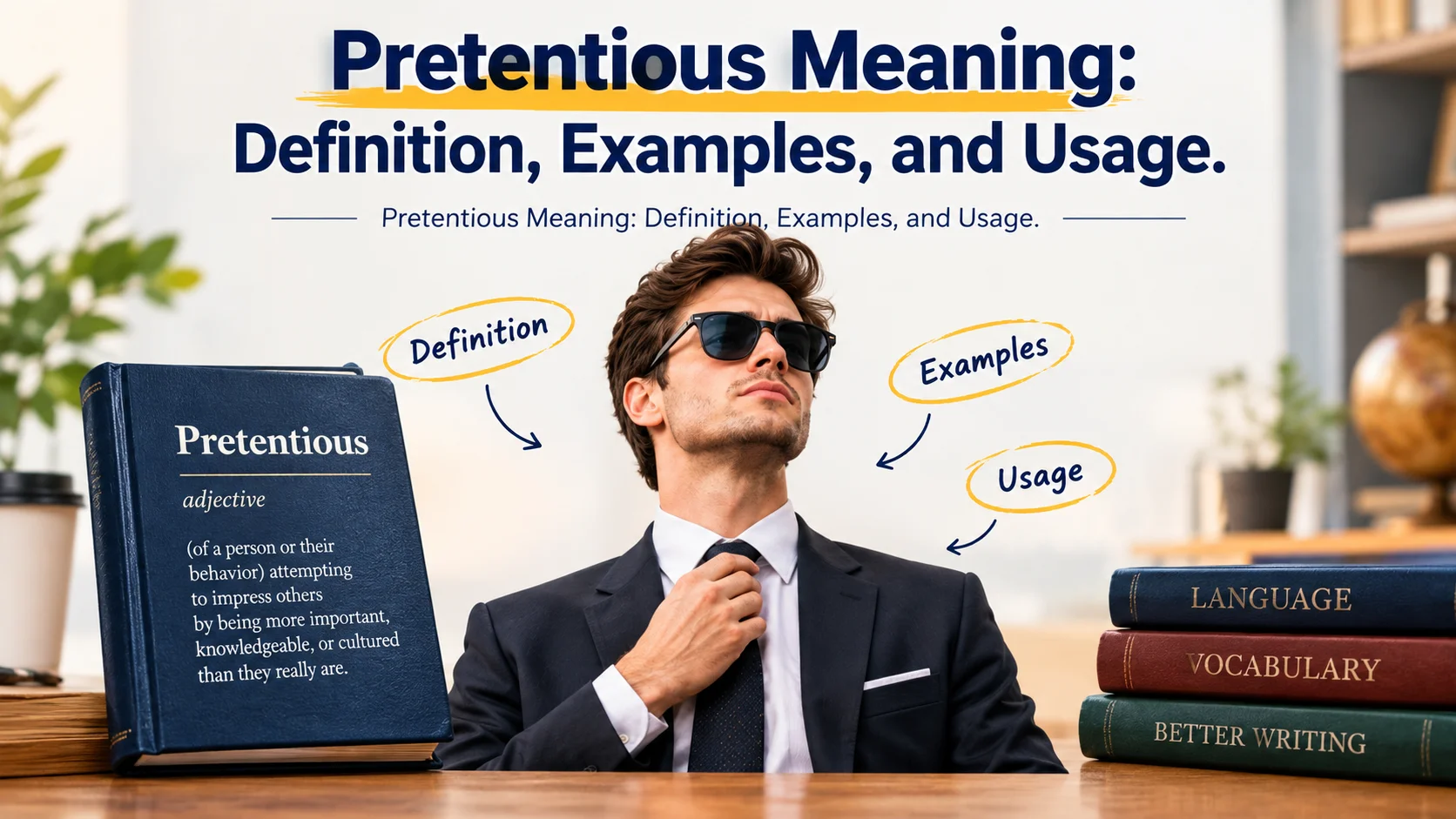
Learn the pretentious meaning in simple English, with examples, synonyms, differences from arrogance, and tips for using the word correctly.
The word pretentious describes a person or thing that tries to appear more important, intelligent, or special than it really is. It is often used when someone shows excessive pride, artificial sophistication, or a desire to impress others. A pretentious person may use complicated language, expensive things, or unusual behavior to create a certain impression. The word can describe speech, writing, behavior, fashion, or even a particular style. For example, someone who uses difficult words unnecessarily may sound pretentious rather than genuinely knowledgeable. Understanding this meaning helps us recognize the difference between confidence, genuine knowledge, and false sophistication. In everyday English, pretentious usually carries a negative meaning and suggests that something feels unnatural.
For example, a person might describe a simple restaurant as offering an extraordinary culinary experience simply to sound fancy or important. Similarly, a writer may use complicated expressions, unnecessary vocabulary, and long sentences to appear highly intellectual. Someone who constantly talks about their expensive lifestyle, exclusive friends, or rare interests may also be called pretentious. However, being educated, stylish, or ambitious does not automatically make someone pretentious. The important difference is whether the person is genuinely expressing themselves or deliberately trying to appear superior. Therefore, the word should be used carefully because calling someone pretentious can sound critical, judgmental, or even insulting. Its meaning depends strongly on the context, intention, and way a person presents themselves.
In everyday conversation, you might say, “His explanation sounded pretentious because he used complex words for a very simple idea.” Another example is, “The movie was visually beautiful, but some of its dialogue felt pretentious and unnatural.” The opposite of pretentious can be described as genuine, natural, humble, or straightforward in many contexts. Learning this word can improve your vocabulary and help you describe behavior that seems designed to impress rather than communicate honestly. Remember that pretentious does not simply mean confident or successful; it specifically suggests an artificial display of importance. Using the word correctly allows you to discuss people, writing, art, and ideas with greater precision. Overall, pretentious behavior is mainly about creating an impressive appearance that may not match reality.
Quick Answer
Pretentious meaning describes someone or something that tries to appear more important, intelligent, sophisticated, or impressive than it really is. In American English, it often suggests forced sophistication or an exaggerated desire to impress others.
TL;DR
• Pretentious usually has a negative or disapproving meaning.
• It describes exaggerated attempts to appear impressive or important.
• Intelligence, wealth, elegance, or confidence aren’t automatically pretentious.
• The word became established in English during the 19th century.
• American usage often focuses on speech, taste, status, and social behavior.
• Its closest direct opposite is unpretentious.
What Does Pretentious Mean?
The simplest definition is “trying to seem more impressive than you really are.” Dictionaries describe it as an attempt to appear more important, intelligent, or sophisticated, especially to impress others.
However, the word doesn’t necessarily mean that the person is actually dishonest. Someone might genuinely enjoy expensive art or complex ideas. The criticism comes from how those interests are presented.
The Core Idea
Think of pretentiousness as a mismatch between substance and presentation.
For example, a person might use a very complicated phrase when a simple phrase would communicate the same idea. If the complicated wording seems designed mainly to sound clever, someone might call it pretentious.
Likewise, a restaurant can be elegant without being pretentious. A formal setting becomes more likely to seem pretentious when it tries too hard to signal status or superiority.
What Can Be Pretentious?
The word can describe many things, including:
• A person who constantly tries to impress others
• Writing filled with unnecessary intellectual language
• A restaurant that overstates its sophistication
• Art that seems intentionally profound without enough substance
• Clothing chosen mainly to communicate social superiority
• A conversation dominated by status or cultural name-dropping
Where Did the Word Pretentious Come From?
The history of “pretentious” helps explain why the word is connected with claims and appearances. Its modern English use developed from French prétentieux, related to prétention and ultimately to Latin praetendere, meaning “to stretch forth” or “put forward.”
The English adjective is recorded from the 19th century. Earlier forms of the word family involved ideas of putting forward a claim, while later meanings developed around exaggerated claims to importance or distinction.
From Claims to Appearance
This history gives the word an interesting underlying idea.
Someone makes a claim about themselves. That claim might involve intelligence, importance, status, culture, or sophistication. Over time, “pretentious” became associated with claims that seem excessive or unsupported.
That’s why the word still carries an idea of projecting more than the situation reasonably supports.
How the Meaning Developed
The modern sense became especially useful when describing behavior, language, art, and social manners.
Today, the word can apply to something as small as an unnecessarily complicated sentence. It can also describe a broader lifestyle or personality.
Read Moe: Spiritual Meaning of a Dirty House: What It Reveals
What Does a Pretentious Person Act Like?
A pretentious person often tries to create a particular impression. The goal may be to appear smarter, wealthier, more cultured, or more important.
Still, one behavior alone doesn’t prove pretentiousness. Context and repeated patterns matter.
Common Signs
• Frequently emphasizing achievements without a natural reason
• Using complicated language mainly to appear intelligent
• Treating ordinary interests as inferior or unsophisticated
• Constantly mentioning famous people or exclusive social connections
• Turning simple conversations into displays of knowledge
• Acting as though certain experiences make someone superior
A knowledgeable person may explain difficult ideas clearly. A pretentious person may make those ideas unnecessarily difficult to emphasize their own intelligence.
That distinction is important.
Is Pretentious the Same as Arrogant?
No. Pretentious and arrogant overlap, but they focus on different things.
Arrogance centers on superiority. A pretentious person focuses more on creating an impressive image.
Pretentious vs. Arrogant
| Word | Main Focus | Typical Impression | Simple Example |
| Pretentious | Appearing impressive | “Look how sophisticated I am.” | Using fancy language unnecessarily |
| Arrogant | Feeling superior | “I’m better than you.” | Dismissing everyone else’s abilities |
| Pompous | Inflated importance | “I deserve special respect.” | Giving an overly grand speech |
| Ostentatious | Excessive display | “Notice what I have.” | Showing off luxury items |
| Confident | Healthy self-belief | “I know what I can do.” | Calmly describing your abilities |
Therefore, someone can be confident without being pretentious.
Likewise, someone can be arrogant without deliberately trying to appear sophisticated. The exact word depends on what you want to criticize.
Confidence vs. Pretentiousness
Confidence usually rests on realistic self-belief.
Pretentiousness involves an exaggerated presentation of importance, intelligence, or sophistication. A confident person can openly admit mistakes, while someone concerned with appearances may struggle to do so.
What Is the Difference Between Pretentious and Pompous?
“Pompous” usually emphasizes an inflated sense of importance. “Pretentious” emphasizes an attempt to appear more impressive than warranted.
For example, a person who constantly talks about their own greatness might sound pompous. A person who uses unnecessarily grand language to make ordinary ideas sound profound might sound pretentious.
A Simple Way to Remember It
Think of the difference like this:
Pompous: “I am extremely important.”
Pretentious: “I want you to think I’m extremely impressive.”
The two can overlap. However, they aren’t exact synonyms.
What Is the Difference Between Pretentious and Ostentatious?
“Ostentatious” usually focuses on showy display, especially when someone wants others to notice wealth, success, or status.
“Pretentious” is broader. It can involve language, behavior, art, taste, education, clothing, or social identity.
Consider These Examples
A person wearing an expensive watch isn’t automatically pretentious or ostentatious.
However, repeatedly drawing attention to the watch to impress people could seem ostentatious. If the person also uses exaggerated language to portray themselves as part of an elite world, “pretentious” may fit better.
What Does Pretentious Mean in American Culture?
In the United States, the word often appears in conversations about authenticity and social behavior. Americans may use it when someone seems overly concerned with appearing sophisticated, cultured, successful, or intellectually superior.
However, American culture contains many different ideas about what counts as sophisticated. What feels natural in one social setting may seem excessive in another.
Everyday American Associations
Pretentiousness may be associated with:
• Overly complicated restaurant descriptions
• Excessive use of academic or professional jargon
• Constant references to elite experiences
• Social media posts designed to signal status
• Art criticism that seems unnecessarily obscure
• People who look down on ordinary preferences
At the same time, American culture also values ambition. Therefore, being ambitious or successful isn’t enough to make someone pretentious.
The issue is usually how those qualities are presented.
Can Something Be Elegant Without Being Pretentious?
Absolutely. Elegance and pretentiousness are not opposites in every situation, but they describe different qualities.
Elegance can suggest beauty, refinement, balance, and restraint. Pretentiousness suggests an exaggerated effort to appear important or sophisticated.
Elegant vs. Pretentious
An elegant home might use quality furniture, simple colors, and thoughtful decoration. It doesn’t need to announce how expensive or exclusive everything is.
Similarly, an elegant person can speak confidently about art without making others feel inferior. Their knowledge feels natural rather than like a performance.
That’s why something can be luxurious and still feel completely unpretentious.
What Does Pretentious Writing Mean?
Pretentious writing tries too hard to sound intelligent, profound, academic, or sophisticated.
The problem isn’t complexity itself. Some subjects genuinely require specialized terms and detailed explanations.
Common Features
• Long words replacing simpler and clearer alternatives
• Grand claims that lack enough supporting substance
• Excessive jargon in ordinary situations
• Abstract language that hides a simple idea
• Dramatic wording used for minor subjects
• Attempts to sound profound rather than communicate clearly
For example, saying “We need to start again” is straightforward.
Calling the same situation “a transformative reconfiguration of our operational paradigm” may sound unnecessarily elaborate in a casual setting.
The second phrase isn’t automatically wrong. Context determines whether it sounds useful or pretentious.
What Are the Synonyms for Pretentious?
Several words are related to pretentious, but each has a slightly different shade of meaning.
Common Alternatives
• Pompous — overly important or self-serious
• Arrogant — showing an exaggerated sense of superiority
• Ostentatious — displaying wealth or status excessively
• Affected — behaving in an unnatural way to impress
• Grandiose — excessively ambitious or impressive
• Conceited — having too much pride in yourself
• Smug — excessively pleased with your own qualities
• Snobbish — showing supposed social or cultural superiority
• Bombastic — using grand language that may lack substance
Choosing the right synonym makes your meaning clearer. For example, “snobbish” may work better when social class or taste is central.
What Is the Opposite of Pretentious?
The clearest opposite is unpretentious. It describes someone or something that doesn’t try to appear more important, intelligent, or special than it really is.
Other related words include humble, modest, sincere, genuine, natural, simple, and unassuming.
What Does Unpretentious Look Like?
An unpretentious person doesn’t need constant recognition. They can enjoy quality things without using them to establish superiority.
An unpretentious restaurant might serve excellent food without making every detail feel like a status test. Likewise, an unpretentious person can be highly educated while remaining approachable.
In many situations, authenticity is the quality people are contrasting with pretentiousness.
How Do You Use Pretentious in a Sentence?
“Pretentious” is an adjective, so it commonly describes a person, object, style, statement, or experience.
Example Sentences
• His pretentious speech made a simple idea difficult to understand.
• The restaurant felt elegant but never pretentious.
• Her writing is intelligent without becoming pretentious.
• The movie’s ending seemed overly pretentious.
• He sounded pretentious when discussing his education.
• The designer created a stylish but unpretentious living room.
• That title sounds pretentious for such a simple project.
• She enjoys classical music without acting pretentious about it.
The word can describe both people and things.
That flexibility makes it common in everyday American conversation.
Why Do People Call Things Pretentious?
Calling something pretentious is often a judgment about presentation. People may feel that the appearance of sophistication has become more important than the actual substance.
However, judgments about pretentiousness can be subjective.
Context Changes the Meaning
A scientific lecture can naturally contain technical vocabulary. A casual conversation probably doesn’t need the same level of specialized language.
Likewise, an experimental art exhibit may intentionally challenge viewers. Calling it pretentious simply because it’s difficult to understand may be unfair.
Therefore, “pretentious” should describe a genuine mismatch between presentation and purpose, rather than simply something you personally dislike.
Can Someone Be Pretentious Without Being Arrogant?
Yes. A person can try to appear sophisticated without believing they’re better than everyone else.
For example, someone might use elaborate language because they want others to think they’re highly educated. That behavior may seem pretentious, even if the person isn’t openly dismissive toward anyone.
Why the Difference Matters
Pretentiousness is often about impression management.
Arrogance is more directly about superiority.
That distinction helps you choose the right word instead of treating every unpleasant personality trait as the same thing.
Is Pretentious Always an Insult?
Usually, “pretentious” is disapproving. Calling a person pretentious generally suggests criticism.
However, the word can sometimes be used lightly or humorously. Friends may jokingly call an elaborate coffee order “pretentious” without making a serious judgment about the person.
Context and Tone Matter
The same word can sound playful among friends and harsh in a professional setting.
Therefore, be careful when using it about someone directly. It can feel personal because it criticizes not just an action, but the image someone is presenting.
How Has the Meaning of Pretentious Changed Over Time?
The modern meaning developed from an older idea of making claims or putting something forward. During the 19th century, the word became associated with exaggerated claims to importance or distinction.
Today, its use has expanded beyond formal writing and social manners.
Modern Usage
People now use “pretentious” for:
• Social media captions and carefully constructed online personas
• Restaurant menus using elaborate descriptions
• Movies that seem overly serious or profound
• Fashion choices intended to signal elite taste
• Corporate language that makes simple ideas sound complicated
• Art, books, music, and cultural commentary
Digital culture has made image-building more visible. As a result, the word remains useful for describing situations where presentation appears more important than substance.
Common Misunderstandings About Pretentious
Because the word is subjective, it’s easy to misuse.
Being Intelligent Isn’t Pretentious
A highly educated person isn’t automatically pretentious. Knowledge becomes relevant when someone appears to use it mainly to create an exaggerated impression.
Being Wealthy Isn’t Pretentious
Expensive possessions don’t automatically signal pretentiousness. The issue is often whether someone uses those possessions to create an exaggerated status image.
Being Different Isn’t Pretentious
Unusual clothing, art, hobbies, or opinions aren’t automatically pretentious. Individual taste can be genuine even when others don’t understand it.
Using Big Words Isn’t Always Pretentious
Some technical terms are necessary for accuracy. The concern appears when complicated language adds appearance without adding useful meaning.
FAQs
What is a simple definition of pretentious?
Pretentious means trying to seem more important, intelligent, sophisticated, or impressive than you really are. It usually carries a negative or disapproving tone.
What is an example of a pretentious person?
Someone who constantly uses complicated language, emphasizes status, and shows off knowledge mainly to impress others may seem pretentious. However, one behavior alone doesn’t prove that someone is pretentious.
Is pretentious the same as arrogant?
No. Arrogance focuses on feeling superior, while pretentiousness focuses on appearing more impressive or important than warranted.
What is the opposite of pretentious?
The closest opposite is unpretentious. Words such as humble, genuine, sincere, modest, and unassuming can also express the opposite idea.
Can an intelligent person be pretentious?
Yes, but intelligence itself isn’t pretentious. A knowledgeable person may seem pretentious when they use their knowledge mainly to create an exaggerated image.
Is pretentious a bad word?
It’s generally a critical word. However, people sometimes use it jokingly, especially when describing overly elaborate language, fashion, food, art, or personal tastes.
Conclusion
The pretentious meaning centers on an exaggerated attempt to appear important, intelligent, sophisticated, or impressive. The word usually points to a gap between what something genuinely is and how impressive it tries to appear. Still, context matters. Being wealthy, educated, artistic, confident, or stylish doesn’t automatically make someone pretentious.
The strongest clue is usually the intention and presentation behind those qualities. When you understand that distinction, “pretentious” becomes much more precise. Instead of using it for anything you dislike, you can use it when appearance seems to overshadow authenticity, substance, or natural confidence.