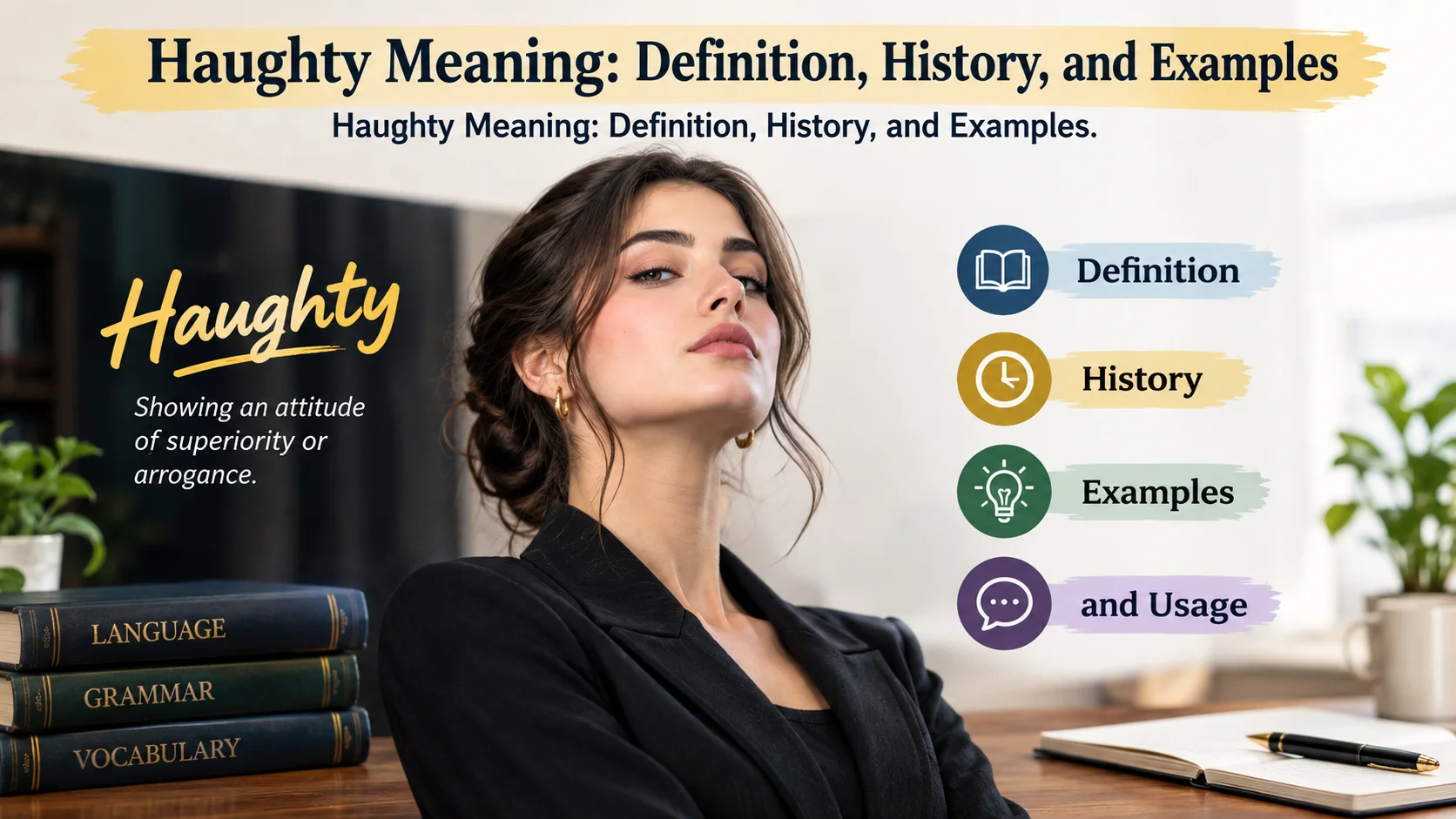
Discover the haughty meaning, its history, synonyms, examples, and subtle differences from arrogant, proud, condescending, and snobbish.
The word haughty is used to describe someone who shows excessive pride, arrogance, and a feeling of superiority over others. A haughty person may act as though they are better, smarter, or more important than the people around them. This behavior can be noticed through their speech, expressions, and general attitude toward others. The word usually has a negative meaning because it suggests a lack of humility, kindness, and respect. Someone who behaves in a cold, proud, or dismissive way may easily be described as haughty. Understanding this word helps readers recognize arrogant behavior in everyday conversations and different forms of writing.
The history of haughty is connected with ideas of being high, elevated, or above other people. The word developed through Middle English and gradually gained its modern connection with pride and arrogance. In earlier usage, the idea of being high could refer to a person’s position, status, or sense of importance. Over time, the meaning became more strongly associated with proud behavior and treating others as inferior. Today, haughty is commonly used as an adjective to describe a person’s attitude, manner, or behavior. Although it is similar to arrogant, haughty often gives an additional sense of coldness, distance, and superiority.
There are many situations in which the word haughty can be used naturally. For example, a person who refuses to speak politely because they believe they are better than others may be called haughty. Someone who gives a superior look, speaks in a dismissive tone, or ignores people may also display haughty behavior. In literature, authors often use this word to describe proud characters who consider themselves more important than everyone else. These examples make the meaning easier to understand because they connect the word with real situations and recognizable behavior. By learning the definition, history, and examples of haughty, English learners can use the word more accurately and confidently.
Quick Answer
What Does Haughty Mean?
The haughty meaning is an unfriendly, overly proud attitude that suggests someone believes they’re superior to others. In the United States, it often describes a person who seems arrogant, distant, snobbish, or condescending.
TL;DR
- Haughty means proudly acting superior to other people.
- It usually carries a strongly negative or disapproving tone.
- The word dates back to the early 1500s.
- Its roots connect with older words meaning “high” or “lofty.”
- American English often associates it with arrogance and social distance.
- Haughty differs from healthy confidence because it looks down on others.
What Does Haughty Mean in Simple English?
A Simple Definition
In simple terms, haughty means acting like you’re better than everyone else.
Imagine someone entering a room and refusing to acknowledge people because they consider themselves more important. Their behavior might be called haughty.
The word describes more than ordinary confidence. Someone can feel proud of an accomplishment without being haughty. Haughtiness appears when pride becomes a sense of superiority over other people.
What Haughty Looks Like
Haughtiness can appear through both words and body language.
For example, a haughty person might:
• Speak to others as though they’re intellectually inferior.
• Give dismissive answers instead of having a normal conversation.
• Act overly important because of wealth or social position.
• Look down on people with different tastes or backgrounds.
• Respond coldly when someone challenges their opinion.
These behaviors don’t automatically prove someone is haughty. Context matters because confidence, shyness, seriousness, and tiredness can look similar.
Haughty Meaning and Word Origin
Where Did Haughty Come From?
The word haughty entered English around the 1520s. It developed from haught, an older word connected with being high or lofty.
That older sense provides an important clue. Being physically “high” gradually gained a figurative meaning of being elevated in status or opinion.
Eventually, the idea shifted toward someone being high in their own estimation. By the early modern period, haughty had developed its familiar sense of proud and disdainful behavior.
The Symbolic Idea of Being “High”
Across many languages, physical height can become a metaphor for status.
Someone “above” others may suggest power, authority, or importance. However, that same image can become negative when it suggests looking down on people.
That figurative pattern helps make haughty easy to understand today.
How Haughty Differs From Arrogant and Proud
Haughty vs. Arrogant
Arrogant and haughty are close in meaning, but they aren’t identical.
Arrogant often emphasizes an exaggerated belief in one’s importance or abilities. Haughty adds a sense of coolness, distance, or disdain toward other people.
For example:
He was arrogant about his intelligence.
This focuses on his inflated opinion of himself.
She gave him a haughty look.
This focuses more on her superior, dismissive manner.
Haughty vs. Proud
Being proud isn’t automatically negative.
You can be proud of your family, your work, or something you’ve achieved. In contrast,
| Word | Main idea | Typical tone | Example |
| Proud | Satisfaction or self-respect | Positive or neutral | She was proud of her achievement. |
| Arrogant | Excessive belief in importance | Negative | He sounded arrogant during the meeting. |
| Haughty | Superior and dismissive behavior | Negative | She gave a haughty response. |
| Condescending | Acting as though others are less capable | Negative | His explanation sounded condescending. |
| Snobbish | Looking down on people based on status or taste | Negative | His snobbish attitude annoyed everyone. |
Haughty Meaning in American English
How Americans Commonly Use It
In American English, haughty is generally a disapproving adjective. It can describe someone’s manner, expression, voice, attitude, or behavior.
For example:
- “She gave me a haughty look.”
- “His haughty manner made people uncomfortable.”
- “The manager sounded haughty during the interview.”
- “Her haughty attitude pushed everyone away.”
The word is more formal than expressions such as stuck-up, snobby, or high and mighty.
Why It Can Sound Literary
You’re more likely to encounter haughty in novels, essays, formal writing, or descriptions of characters.
However, Americans still use it in everyday conversation when they want a precise word for a superior attitude.
Haughty Meaning in Social and Cultural Contexts
Status and Social Position
Haughtiness often appears in situations involving status.
Historically, people associated wealth, rank, education, and power with social position. Someone who acted as though their position made them better than others could be described as haughty.
Today, the same idea can appear in different settings.
• Wealth can create an appearance of social superiority.
• Professional success can sometimes produce an inflated ego.
• Academic achievement may become a source of elitist behavior.
• Fashion and taste can become markers of social distinction.
• Online popularity can encourage displays of superiority.
Still, these associations don’t mean that successful or wealthy people are naturally haughty. The word describes behavior, not a social group.
Read more: Conceited Meaning: Definition, Examples & Traits
Haughty Personality Traits and Emotional Meaning
What Does Haughtiness Signal?
Haughtiness commonly signals an exaggerated sense of superiority.
Psychologically, observers may interpret the behavior as confidence taken too far. Yet it’s important not to assume what someone privately feels from one interaction.
A person may appear haughty because they’re uncomfortable, defensive, formal, or simply misunderstood.
Common Emotional Associations
People often connect haughtiness with feelings such as:
• Superiority toward people viewed as less important.
• Disdain for opinions that differ from their own.
• Emotional distance during social interactions.
• Self-importance after gaining recognition or authority.
• Irritation when others challenge their position.
The key idea is social comparison. Haughtiness places the speaker or character above others in some imagined hierarchy.
Haughty Behavior: Examples in Everyday Life
Example 1: Workplace
Imagine an employee who constantly reminds coworkers about their credentials.
When someone offers a suggestion, they respond, “You wouldn’t understand the way this works.”
That response can sound haughty because it dismisses the other person’s ability.
Example 2: Social Situation
Suppose someone refuses to speak with another guest because they consider that person unimportant.
Their silence might feel cold rather than merely quiet. If their behavior communicates superiority, haughty could describe it.
Example 3: Online Conversation
A person might respond to a beginner’s question with a sarcastic comment.
Instead of helping, they make the questioner feel foolish. That behavior can be described as haughty or condescending.
Haughty vs. Condescending
What’s the Difference?
These words overlap, but they emphasize different things.
Haughty focuses on an attitude of superiority. Condescending focuses more specifically on treating someone as though they’re less intelligent, capable, or informed.
For example, a person can be haughty without speaking directly to someone. Their expression alone might communicate superiority.
By contrast, condescension usually appears during an interaction.
Haughty vs. Patronizing
Patronizing is also closely related. A patronizing person may pretend to be helpful while subtly treating another person as inferior.
A haughty person may simply maintain a distant, superior attitude.
Understanding these differences helps you choose the strongest word for a specific situation.
Haughty in Literature and Storytelling
Why Writers Use the Word
Writers often use haughty to establish a character quickly.
Instead of describing someone’s entire personality, the word can suggest pride, distance, status, and disdain in one stroke.
A character with a haughty expression might have their chin raised and speak formally. Another might remain silent while looking down on everyone around them.
The Classic Character Type
Literature has long used proud and socially superior characters.
They may begin as wealthy aristocrats, powerful leaders, proud rivals, or socially ambitious figures. Sometimes the story later challenges their attitude.
This makes haughtiness useful for character development. It can show a flaw that eventually changes through experience.
Haughty Meaning in Religion and Older Moral Traditions
Pride as a Moral Theme
The broader idea behind haughtiness appears in many moral and religious traditions.
Pride has often been contrasted with humility. In Christian traditions, for example, excessive pride has historically been treated as a serious moral problem.
However, haughty itself isn’t a religious symbol. It’s an English adjective describing a particular form of prideful behavior.
Other cultures and philosophical traditions also explore the tension between dignity, pride, humility, and social status. Their teachings differ, so they shouldn’t be reduced to one simple definition.
Haughtiness and Humility
The strongest contrast is often haughtiness versus humility.
Humility doesn’t necessarily mean thinking poorly of yourself. Instead, it can mean recognizing your own limits without needing to place others beneath you.
That distinction remains useful in modern American culture.
Haughty Meaning in Modern Culture
Social Media and Online Identity
Social media can make attitudes highly visible.
A person’s captions, comments, photographs, or responses can create an impression of superiority. However, online presentation can also be carefully staged.
Therefore, calling someone haughty based on one post may be unfair.
Fashion and Personal Style
Fashion sometimes uses confident, distant, or dramatic poses.
A model’s raised chin or serious expression might look haughty in one context. Yet that doesn’t mean the person actually feels superior.
Instead, the appearance may simply communicate elegance, power, mystery, or confidence.
Home Decor and Visual Style
The word can also appear in descriptions of characters or settings with an elegant, formal atmosphere.
However, haughty isn’t a standard decorative symbol. Its connection to grandeur comes mainly from the idea of status and elevated position.
Is Haughty Always an Insult?
Usually, But Context Matters
Haughty is generally negative or disapproving. Major dictionaries define it around unreasonable pride, superiority, or unfriendly behavior
Still, writers sometimes use it playfully.
For example, someone might jokingly call a cat “haughty” because it ignores everyone and behaves like royalty.
In that context, the word becomes humorous rather than seriously insulting.
Can Haughty Be Positive?
Historically, related forms could carry meanings involving loftiness, nobility, or dignity. That older sense is now largely archaic.
Modern American English usually doesn’t use haughty as a compliment.
If you want to describe healthy confidence, words like self-assured, confident, dignified, or poised are usually better.
Common Misunderstandings About Haughty
Haughty Doesn’t Mean Confident
Confidence means believing in your abilities.
Haughtiness adds the belief that you’re above other people. That’s why a confident person can be respected, while a haughty person may alienate others.
Haughty Doesn’t Mean Quiet
A quiet person isn’t necessarily haughty.
Someone might be shy, thoughtful, tired, or uncomfortable. Haughtiness requires some sense of superiority or dismissiveness.
Haughty Doesn’t Automatically Mean Wealthy
Money and status can sometimes provide a setting for haughty behavior. However, anyone can behave haughtily.
The word describes an attitude rather than a person’s income or background.
Haughty Synonyms and Antonyms
Common Synonyms
Several words overlap with haughty, but each has its own shade of meaning.
• Arrogant — excessively confident about one’s importance.
• Condescending — treating others as less capable or intelligent.
• Snobbish — judging people through status, taste, or class.
• Supercilious — showing a proud and contemptuous attitude.
• Pompous — behaving with excessive self-importance.
• Imperious — expecting obedience because of perceived authority.
These words can replace haughty in some sentences, but not all.
Common Antonyms
The clearest opposites include humble, modest, unassuming, and approachable.
For example:
She was confident but approachable.
That sentence describes someone who believes in herself without treating others as inferior.
How the Meaning of Haughty Has Changed
From “High” to “Superior”
The history of haughty shows a familiar language pattern.
Physical height once provided the foundation for a metaphor. Something high could become associated with greatness, rank, or importance.
Over time, the word moved toward a negative idea of being too elevated in one’s own opinion.
Today, the older positive sense is uncommon. The modern meaning strongly centers on arrogance and disdain.
What the Shift Tells Us
Language often preserves older ideas while changing their emotional tone.
The journey of haughty shows how “being high” can move from describing status to criticizing someone who thinks too highly of themselves.
That makes the word especially useful when discussing pride and social behavior.
FAQs
Is Haughty a Negative Word?
Yes. Haughty normally has a negative or disapproving meaning. It suggests that someone acts superior, proud, distant, or dismissive toward others.
What Is an Example of a Haughty Person?
A person who constantly treats others as inferior may be described as haughty. For example, someone who dismisses every coworker’s opinion because they think they’re more intelligent could appear haughty.
Is Haughty the Same as Arrogant?
They’re very similar, but haughty often suggests a colder or more distant sense of superiority. Arrogant can focus more broadly on an exaggerated opinion of one’s importance or abilities.
What Is the Opposite of Haughty?
Common opposites include humble, modest, unassuming, and approachable. The exact opposite depends on the sentence and context.
Can Haughty Be Used for Someone’s Voice?
Yes. You can describe a voice, tone, manner, expression, or response as haughty. For example, “Her haughty tone made the conversation uncomfortable.”
What Is the Difference Between Haughty and Snobby?
Haughty focuses on a superior attitude toward others. Snobby often involves judging people based on social status, wealth, education, fashion, or taste.
Conclusion
The haughty meaning centers on excessive pride combined with an attitude of superiority. In modern American English, it usually describes someone who seems distant, dismissive, arrogant, or convinced they’re better than others.The word has traveled a long way from older ideas of being “high” or “lofty.” Today, it offers a precise way to describe pride that crosses the line into social superiority. Understanding that difference can help you choose between haughty, arrogant, condescending, snobbish, and confident. When you see the word, think less about simple pride and more about looking down on others.














1 thought on “Haughty Meaning: Definition, History, and Examples”