Learn the supercilious meaning, its Latin origin, modern American usage, synonyms, examples, and how it differs from arrogant or condescending.
Supercilious meaning refers to a person who shows arrogance, pride, superiority, or an attitude of looking down on others. Someone who is supercilious may behave as though they are better, smarter, more important, or more deserving than everyone around them. The word often describes a haughty attitude, facial expression, tone, or manner that makes other people feel inferior. In everyday English, supercilious behavior can be seen when someone dismisses opinions, ignores others, or speaks with unnecessary confidence. Understanding the meaning of supercilious can help English learners describe arrogant behavior more accurately and naturally. This useful adjective commonly appears in formal writing, literature, conversations, and descriptions of people’s social behavior.
The origin of supercilious comes from the Latin word supercilium, which means “eyebrow” and was associated with pride or haughtiness. The connection developed from the expression of raising an eyebrow, which can suggest disapproval, contempt, or a feeling of superiority. The word eventually entered English through French influence and developed the modern sense of behaving in a proud or disdainful way. Its history shows how a simple physical gesture could become connected with a particular attitude and personality trait. Today, supercilious remains a useful word for describing people who display condescending, arrogant, or superior behavior. Learning its definition and origin makes it easier to understand the word when it appears in books, articles, speeches, or conversations.
There are many examples of supercilious behavior in everyday situations, especially when someone treats others with disrespect or superiority. For example, a person who laughs at someone’s question because they believe it is too simple may be described as supercilious. A manager using a condescending tone while dismissing employees’ ideas could also be showing a supercilious attitude. A sentence such as, “His supercilious expression and arrogant tone annoyed everyone at the meeting,” demonstrates natural usage. Common synonyms of supercilious include haughty, arrogant, conceited, and disdainful, though their exact meanings can differ slightly. By studying its meaning, origin, examples, and synonyms, learners can use supercilious confidently in both written and spoken English.
Quick Answer
What Does Supercilious Mean?
Supercilious meaning refers to behaving as though you’re superior to other people, often with a cool, proud, or disdainful attitude. In the United States, it usually describes someone who appears arrogant, haughty, or condescending.
TL;DR
- Supercilious means proudly acting superior to other people.
- The word comes from Latin and relates to the eyebrow.
- It usually has a negative or disapproving tone.
- A supercilious person may seem cold, smug, or dismissive.
- American English uses it mainly in formal or descriptive contexts.
- Similar words include haughty, arrogant, disdainful, and condescending.
What Is the Definition of Supercilious?
The Basic Meaning
Supercilious is an adjective. It describes someone who behaves as if they’re better than other people.
The attitude often feels cool rather than openly angry. Someone may not insult you directly, yet their expression or tone can still communicate contempt.
For example:
“The manager gave the customer a supercilious smile.”
This suggests that the manager’s smile showed superiority or disdain.
Cambridge defines the word as behaving as though your opinions, beliefs, or ideas are more important than those of others. Oxford similarly describes someone who behaves toward others as though they’re superior.
What Does a Supercilious Person Act Like?
A supercilious person might:
- Dismiss another person’s opinion without considering it.
- Speak in a patronizing or superior tone.
- Look down on people they consider less knowledgeable.
- React to simple questions with visible impatience.
- Use facial expressions that suggest contempt or superiority.
The key idea is attitude. Someone can be confident without being supercilious.
What Does Supercilious Mean in American English?
How Americans Use the Word
In American English, supercilious usually sounds formal, literary, or polished. It’s less common in casual conversation than words such as arrogant, snobby, or stuck-up.
For example, an American speaker might say:
“He’s acting stuck-up.”
In a more formal setting, they might write:
“His supercilious manner alienated his colleagues.”
Collins lists the American meaning as disdainful or contemptuous, with an emphasis on pride, scorn, and haughtiness.
The Tone of the Word
Supercilious is almost always negative.
However, it doesn’t necessarily describe loud or aggressive behavior. Instead, the person may appear calm, distant, polished, and quietly dismissive.
That subtle quality makes the word useful when arrogant feels too broad.
Where Did the Word Supercilious Come From?
The Latin Connection
The word comes from the Latin superciliosus, meaning haughty or arrogant. That word developed from supercilium, which meant “eyebrow” and also carried figurative meanings connected with pride and haughtiness.
The connection is easy to picture.
Imagine someone raising one eyebrow after hearing something they consider foolish. Over time, that facial gesture became associated with an attitude of superiority.
English adopted supercilious in the early 16th century. Merriam-Webster notes that its modern sense of censoriously overbearing behavior became established later, while an older eyebrow-related sense eventually disappeared.
From Facial Expression to Character
The history shows how language can grow from body language.
An eyebrow is physical. A raised eyebrow can signal judgment. That judgment can suggest pride or contempt. Eventually, the word came to describe the entire attitude.
So the word’s history follows a simple path:
eyebrow → raised eyebrow → haughty expression → superior attitude
Is Supercilious a Negative Word?
Why It Usually Sounds Critical
Yes. Supercilious is normally disapproving.
Calling someone supercilious suggests more than confidence. It implies that the person displays an unpleasant sense of superiority.
For instance:
“She was confident during the presentation.”
This sounds positive or neutral.
Compare it with:
“She was supercilious during the presentation.”
Now the sentence suggests that she treated others as inferior.
Confidence vs. Superiority
Confidence and superciliousness aren’t the same.
| Behavior | Meaning in the USA | Common Association | Tone |
| Confidence | Trust in your abilities | Self-assurance | Usually positive |
| Pride | Satisfaction in achievement | Accomplishment | Neutral or positive |
| Arrogance | Inflated sense of importance | Ego | Negative |
| Condescension | Treating others as inferior | Talking down | Negative |
| Superciliousness | Cool, disdainful superiority | Haughty attitude | Strongly negative |
The difference matters because someone can know more without looking down on others.
Supercilious vs. Arrogant
What Is the Difference?
Arrogant is broader. It describes someone who has an exaggerated sense of their own importance or ability.
Supercilious adds a particular attitude toward other people.
Merriam-Webster describes supercilious as “coolly and patronizingly haughty,” while its thesaurus explains that the word suggests a cool, patronizing form of superiority.
Consider these examples:
“He’s arrogant about his achievements.”
This focuses on his inflated view of himself.
“He gave his coworkers a supercilious look.”
This focuses on how he treats others.
Therefore, arrogance is about self-importance, while superciliousness often shows that superiority outwardly.
Supercilious vs. Condescending
How Are They Different?
These words overlap, but they emphasize different things.
Condescending focuses strongly on treating another person as inferior. Supercilious emphasizes a proud, disdainful, and superior manner.
For example:
“Her condescending explanation made me feel like a child.”
The speaker feels talked down to.
Now consider:
“Her supercilious expression made everyone uncomfortable.”
The focus is her superior attitude and visible disdain.
Cambridge places condescending, haughty, superior, and self-important among words closely related to supercilious.
Read More: Pompous Meaning: Definition, Examples, and Why It Matters
Supercilious vs. Haughty, Pompous, and Snobbish
Choosing the Right Word
Several English words can describe similar behavior. Still, each has a slightly different focus.
- Haughty: Proud and visibly superior.
- Arrogant: Too confident in your own importance.
- Pompous: Overly important or grand in speech or manner.
- Snobbish: Socially or culturally superior toward others.
- Condescending: Treating someone as though they’re inferior.
- Disdainful: Showing strong lack of respect.
- Supercilious: Coolly displaying superior, contemptuous pride.
Merriam-Webster and Collins both list many of these as close alternatives.
Which Word Sounds Most Natural?
In everyday American conversation, arrogant and condescending are usually more common.
Supercilious works especially well when you want a precise, formal description.
That’s why it appears naturally in essays, literary criticism, formal descriptions, and sophisticated character writing.
What Are Some Examples of Supercilious?
Everyday Examples
Understanding the word becomes easier when you see it in context.
- “He gave me a supercilious glance when I asked for help.”
- “Her supercilious tone made the conversation uncomfortable.”
- “The critic sounded supercilious when discussing popular music.”
- “His supercilious smile suggested that he knew better.”
- “The executive’s supercilious manner annoyed the entire team.”
Each example suggests superiority combined with some degree of disdain.
Supercilious in Literature
Writers often use the word to quickly establish a character’s personality.
A supercilious character may appear wealthy, powerful, educated, socially important, or simply convinced of their own superiority. The word can therefore communicate character traits without requiring a long explanation.
It’s especially effective when describing facial expressions, voices, gestures, and manners.
What Does a Supercilious Expression Look Like?
The Raised-Eyebrow Connection
The word’s history makes facial expression especially important.
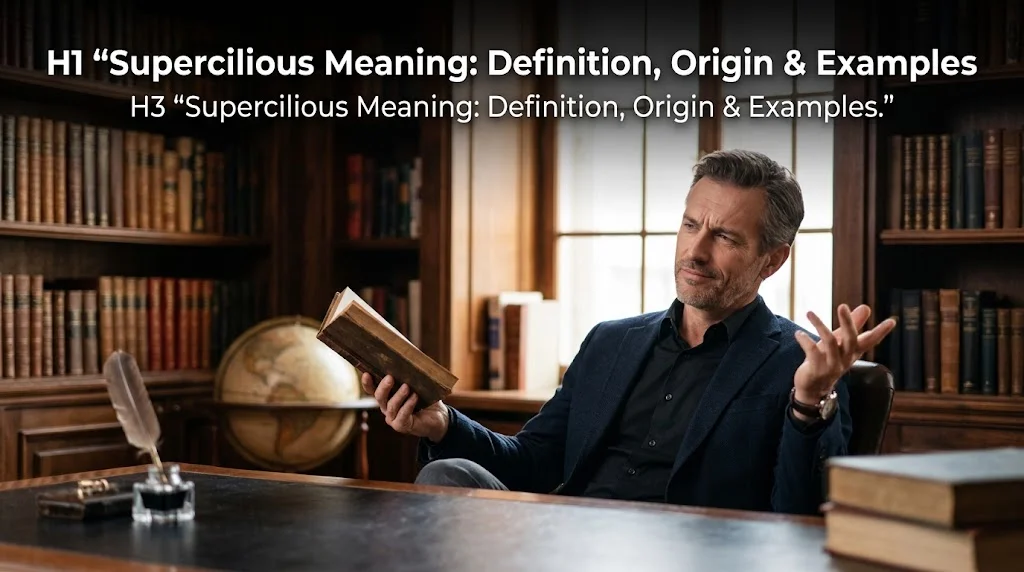
A supercilious expression might include a raised eyebrow, slight smirk, narrowed eyes, or an emotionally distant look. None of these gestures automatically means contempt, however.
Context matters.
A raised eyebrow can signal surprise, curiosity, humor, or doubt. It becomes supercilious when the broader expression communicates superiority or disdain.
Body Language and Tone
A supercilious attitude can also appear through:
- Looking away while someone speaks.
- Smirking after another person makes a mistake.
- Using an exaggeratedly patient voice.
- Correcting someone unnecessarily to display knowledge.
- Responding as though basic questions are beneath you.
These behaviors don’t prove someone feels superior. They simply illustrate how the word is commonly understood.
What Does Supercilious Say About Personality?
Emotional Associations
The word often brings several impressions together.
A supercilious person may appear:
- Proud
- Dismissive
- Aloof
- Smug
- Judgmental
- Self-important
- Contemptuous
These associations explain why the word usually creates an uncomfortable emotional reaction.
Instead of inviting connection, the attitude creates distance. The other person may feel ignored, judged, or treated as less important.
Why People Notice It
Humans pay close attention to social signals.
A facial expression, tone of voice, or dismissive response can communicate status without saying it directly. That’s one reason supercilious remains useful as a descriptive word.
How Is Supercilious Used in Modern American Culture?
Social Media and Online Communication
Today, the attitude can appear in digital conversations as well.
A person might sound supercilious through sarcastic replies, dismissive comments, or responses that mock another person’s lack of knowledge.
However, online communication creates a problem: tone is difficult to read.
A short message may seem supercilious even when the writer intended to be neutral. Therefore, context remains important.
Workplace and Education
The word also fits professional and academic settings.
For example, an expert may know considerably more about a subject. That expertise isn’t supercilious by itself.
The problem begins when expertise becomes a way to belittle others.
A teacher, manager, doctor, researcher, or specialist can communicate authority without communicating contempt.
Why Does Superciliousness Feel So Unpleasant?
The Psychology of Social Superiority
Supercilious behavior can create a strong sense of social distance.
When someone acts superior, the other person may feel excluded from the conversation. The message can seem to be, “You’re beneath me.”
That’s why the word often carries emotional associations with embarrassment, irritation, frustration, or resentment.
Status and Respect
American culture often values confidence and achievement. At the same time, people generally distinguish confidence from treating others poorly.
Someone can be successful, educated, wealthy, talented, or influential without being supercilious.
The attitude matters more than the person’s status.
Common Misunderstandings About Supercilious
It Doesn’t Simply Mean “Smart”
A common mistake is treating supercilious as a synonym for intelligent.
It isn’t.
A highly intelligent person can be humble and respectful. Likewise, a person with little expertise can behave superciliously.
The word describes attitude, not intelligence.
It Doesn’t Always Mean Open Insult
Another misunderstanding is that a supercilious person must openly insult someone.
That isn’t necessary.
A facial expression, dismissive tone, or superior manner can communicate the same idea without direct insults. This subtlety is one of the word’s most useful features.
How Has the Meaning of Supercilious Changed Over Time?
An Older Physical Sense
The earliest history connects the word with the eyebrow and facial expression.
Merriam-Webster notes that supercilious once had an obsolete sense related to the eyebrow itself. That meaning eventually disappeared from ordinary English.
The figurative meaning became much more important.
The Modern Meaning
Today, the word primarily describes behavior marked by superiority, haughtiness, or disdain.
Its meaning has therefore become more psychological and social than physical.
The eyebrow remains important mainly as a memorable clue to the word’s origin.
How Can You Remember the Supercilious Meaning?
Use the Eyebrow Trick
A simple memory trick connects supercilious with a raised eyebrow.
Imagine someone hearing an ordinary comment and lifting one eyebrow as if to say, “Really?”
Then imagine that expression carrying a sense of superiority.
That picture can help you remember:
Supercilious = acting superior with a haughty, disdainful attitude.
A Simple Memory Sentence
Try this:
“She raised an eyebrow in a supercilious way.”
The sentence connects the modern meaning with the word’s Latin history.
FAQs
What is the simple meaning of supercilious?
Supercilious means behaving as though you’re better or more important than other people. It usually suggests a proud, dismissive, or disdainful attitude.
Is supercilious a bad word?
It’s generally a negative or disapproving word. Calling someone supercilious usually criticizes their attitude toward other people.
Is supercilious the same as arrogant?
Not exactly. Arrogant focuses on an exaggerated sense of self-importance, while supercilious emphasizes cool, disdainful superiority toward others.
What is a synonym for supercilious?
Common synonyms include haughty, arrogant, disdainful, condescending, pompous, and snobbish. The best choice depends on the exact behavior you want to describe.
What is the opposite of supercilious?
Words such as humble, modest, respectful, and unassuming can express opposite ideas. They suggest that someone doesn’t consider themselves superior to others.
How do you pronounce supercilious?
In American English, it’s commonly pronounced approximately soo-per-SIL-ee-us. The main stress falls on the middle syllable.
Conclusion
The supercilious meaning centers on a cool, proud sense of superiority toward other people. It describes more than confidence because it usually includes disdain, dismissal, or haughtiness. Its history makes the word especially memorable. The Latin connection to the eyebrow reflects the old idea of raising one’s brow to show pride or contempt. Today, supercilious remains a useful word for describing a person’s tone, expression, or manner. When you see it in American English, think of someone looking down on others rather than simply feeling confident.