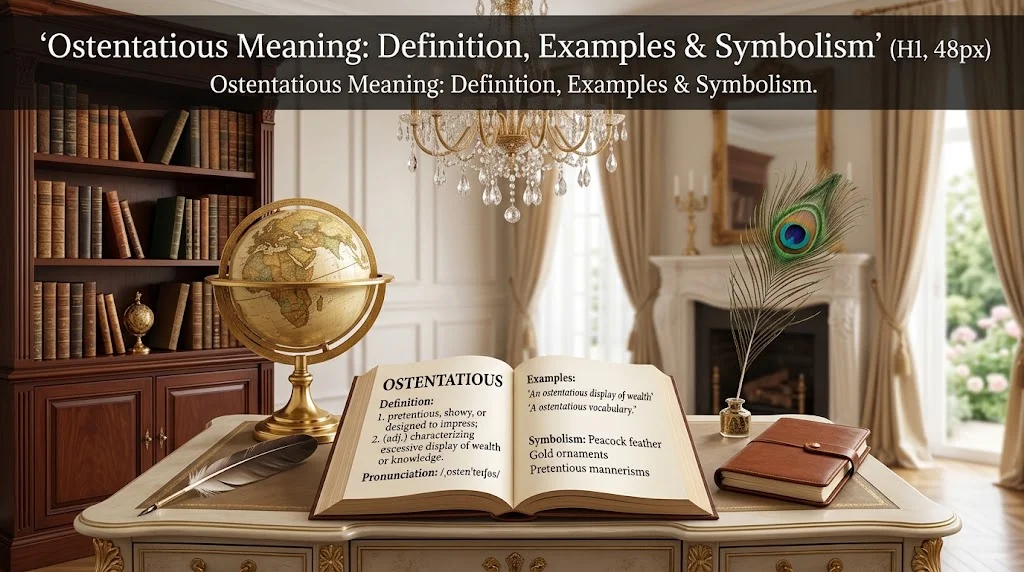
Ostentatious Meaning: Definition, Examples & Symbolism
Learn the ostentatious meaning, its history, examples, American cultural context, and how it differs from being confident, stylish, or simply extravagant.
In everyday American English, you might hear someone describe an expensive mansion, flashy jewelry, a luxury car, or a dramatic gesture as ostentatious. The word is commonly used when something appears excessively showy, extravagant, or designed to attract attention. It can describe more than expensive possessions, however, because people also use it for behavior, clothing, speech, and public displays. An ostentatious style often makes a strong impression because it emphasizes appearance, wealth, and status. The meaning can be positive in rare contexts, but it is more often used with a critical or negative tone. Understanding this distinction makes it easier to recognize how the word works in everyday conversations.
The word ostentatious can also describe decorations, celebrations, gestures, and even simple actions when they seem deliberately attention-seeking. For example, an elaborate party may be called ostentatious if its decorations, entertainment, and expenses appear unnecessarily extravagant. Likewise, someone who constantly talks about their achievements or displays expensive possessions may be viewed as ostentatious behavior. The important idea is not simply that something is beautiful, expensive, or impressive. Instead, the word suggests that the display is unusually noticeable, excessive, and intended to impress others. This helps separate ordinary luxury from behavior that seems designed mainly for public attention or admiration.
Today, the idea is especially interesting because American culture often celebrates success while also placing value on modesty and authenticity. A person can enjoy designer clothing, a beautiful home, or other forms of luxury without necessarily being called ostentatious. The difference often depends on how visibly and deliberately that luxury is displayed. Someone who quietly enjoys expensive things may simply be described as successful or affluent, while someone who constantly showcases them may be considered ostentatious. In this way, the word reflects broader ideas about wealth, social status, appearance, and personal expression. Learning these subtle differences can help you use ostentatious accurately in both writing and conversation.
Quick Answer
The ostentatious meaning in the United States usually suggests an excessive display of wealth, power, status, or importance intended to gain attention or admiration. More broadly, it can describe anything done in an overly noticeable or showy way.
TL;DR
- Ostentatious means noticeably showy, especially when displaying wealth or status.
- The word usually has a disapproving or critical tone.
- Its roots trace back to Latin words connected with displaying or showing.
- American culture often connects ostentation with luxury, status, and social image.
- Being stylish or successful doesn’t automatically make someone ostentatious.
- Today, social media can make displays of wealth especially visible.
What Does Ostentatious Mean?
Simple Definition
Ostentatious describes something designed to attract notice, especially through an obvious display of wealth, importance, or power. Dictionaries commonly mark the word as disapproving because the display can seem excessive or self-important.
For example, an enormous diamond necklace may be luxurious without being ostentatious. If someone deliberately makes sure everyone notices the necklace and its price, however, the description becomes more fitting.
The word can also describe actions. Someone might give an ostentatious sigh, make an ostentatious gesture, or behave in an ostentatious manner simply to make sure others notice.
What Does the Word Suggest?
The important idea isn’t simply expense. Instead, ostentation involves visible display and intention.
Common associations include:
• Showing wealth publicly
• Seeking admiration or attention
• Emphasizing social status
• Making something unnecessarily noticeable
• Appearing flashy or extravagant
What Is the Origin of Ostentatious?
Latin Roots
The history of ostentatious reaches back through French to Latin. The related Latin verb ostentare meant to display or show something, while ostendere meant to show or expose something to view.
Over time, the idea of showing something developed a stronger connection with deliberate display. Eventually, the English word became associated with showing off wealth, importance, or possessions.
The noun ostentation appeared in English centuries before the adjective became common. The adjective ostentatious is recorded from the early 1700s.
From Display to Vanity
Earlier uses emphasized display itself. Later meanings increasingly suggested vanity, pride, and excessive show.
That change matters because modern English usually carries a judgment. Calling something ostentatious isn’t simply saying, “People noticed it.” You’re often suggesting that the display was unnecessary or meant to impress.
What Does Ostentatious Symbolize in America?
Wealth and Social Status
In the United States, ostentation often symbolizes visible success. Luxury cars, enormous homes, designer clothing, expensive watches, and lavish parties can all become symbols of financial achievement.
However, American attitudes toward these displays aren’t uniform. Some people see them as evidence of ambition and success, while others see them as excessive or insecure.
The American Success Story
American culture has long connected material success with achievement. Yet it also has a strong tradition of admiring simplicity, independence, and humility.
This creates an interesting tension. A successful person may receive praise for working hard, but excessive displays of success can still attract criticism.
That tension explains why words such as modest, understated, and unpretentious often appear as opposites of ostentatious.
How Does Ostentatious Behavior Look?
Everyday Examples
Ostentatious behavior doesn’t always involve millions of dollars. Even ordinary situations can feel ostentatious when someone deliberately makes a display.
Consider these examples:
• Constantly mentioning the price of your new clothes
• Showing off an expensive purchase during every conversation
• Making dramatic gestures simply to attract attention
• Turning a private achievement into a public spectacle
• Decorating every surface with flashy luxury items
The key is the display, not simply the possession.
Ostentatious Objects
Objects can also appear ostentatious because of their size, decoration, rarity, or presentation.
An oversized gold watch may look ostentatious. So might a mansion filled with unnecessary decorations or a vehicle covered in highly noticeable modifications.
Still, context matters. A theatrical costume, for example, may be intentionally dramatic without being ostentatious.
Read More : Supercilious Meaning: Definition, Origin & Examples
What Is the Difference Between Ostentatious and Extravagant?
These words overlap, but they aren’t identical.
Extravagant often means excessive, unusually expensive, or beyond what seems necessary. Ostentatious adds the idea of public display and attention.
| Context | Extravagant | Ostentatious |
| Expensive gift | Very costly or excessive | Displayed to impress others |
| Large home | Bigger than necessary | Designed to signal status |
| Clothing | Unusually elaborate | Deliberately attention-grabbing |
| Party | Very lavish | Lavish and visibly impressive |
| Lifestyle | Excessive spending | Public display of wealth |
Therefore, something can be extravagant without being ostentatious.
A person might quietly spend a large amount on a private vacation. That could be extravagant, but it isn’t necessarily ostentatious.
Ostentatious vs. Pretentious: Are They the Same?
A Small but Important Difference
Pretentious usually suggests that someone tries to appear more important, intelligent, cultured, or sophisticated than they really are.
Ostentatious, meanwhile, focuses more strongly on obvious display.
For example, someone using complicated words to sound intelligent may seem pretentious. Someone wearing extremely expensive jewelry to attract attention may seem ostentatious.
Sometimes the two qualities overlap. A person can also be both pretentious and ostentatious.
Why Context Matters
Calling someone ostentatious can be a strong criticism. It suggests more than simply saying that the person enjoys nice things.
The speaker is usually commenting on the person’s presentation and apparent motivation.
Is Ostentatious Always Negative?
The Usual Tone
Ostentatious is generally used negatively or critically. Major English dictionaries describe it as involving an excessive or obvious attempt to attract notice.
Still, context can soften the judgment.
For example, a writer might describe an elaborate historical building as ostentatious without strongly criticizing the people who built it. In another context, the word may clearly suggest vanity.
Style Isn’t Automatically Ostentation
A person can dress boldly, own expensive possessions, or enjoy beautiful surroundings without being ostentatious.
The distinction often depends on intention and presentation.
Someone might buy a bright outfit because they genuinely love its design. Another person might choose the same outfit mainly because they want everyone to notice its price.
The visible object is similar, but the social meaning changes.
What Are the Psychological Associations of Ostentation?
Attention and Recognition
Ostentatious behavior is often associated with a desire for recognition. The person may want others to notice success, wealth, influence, beauty, or social position.
However, you can’t reliably know someone’s private motives from appearance alone. A flashy lifestyle may have many explanations.
Identity and Social Signaling
People often use clothing, possessions, homes, and experiences to communicate identity.
In that sense, ostentation can function as a form of social signaling. The display says something like, “I can afford this,” “I’m important,” or “I belong in this social group.”
That message may be intentional or unconscious.
How Does Social Media Influence Ostentation?
Public Display in the Digital Age
Social media has made personal displays more visible than ever. Luxury vacations, designer purchases, elaborate homes, and expensive experiences can be photographed and shared instantly.
As a result, ostentation isn’t limited to physical spaces. A carefully arranged digital profile can also communicate wealth or status.
The Performance of Success
Online platforms can turn everyday life into a public presentation. People may select particular photos because those images communicate achievement or lifestyle.
However, sharing something expensive doesn’t automatically make it ostentatious. Context, frequency, presentation, and apparent purpose all matter.
What Does Ostentatious Mean in Fashion and Design?
Clothing and Jewelry
In fashion, ostentatious often describes items that are highly noticeable. Large gemstones, excessive decoration, bold patterns, and prominent luxury branding may receive this label.
Yet fashion is also about creativity. Something dramatic can be artistic, playful, or expressive without necessarily being ostentatious.
Home Decor
In interior design, ostentation may appear through excessive ornament, oversized furniture, elaborate finishes, or combinations intended to communicate luxury.
American design has moved through many periods where dramatic interiors were fashionable. Today, minimalism and understated luxury often provide a contrasting aesthetic.
What Are the Cross-Cultural Meanings of Ostentation?
A Universal Human Pattern
The desire to display wealth or status isn’t unique to the United States. Across history, societies have used clothing, architecture, jewelry, feasts, and ceremonies to communicate social position.
However, what counts as excessive varies greatly between cultures and historical periods.
Different Standards of Display
One culture may view a lavish celebration as appropriate and respectful. Another may see the same display as excessive.
Therefore, it’s important not to treat ostentation as a universal judgment. Social expectations shape whether visible wealth feels impressive, normal, generous, or excessive.
How Has the Meaning Changed Over Time?
Medieval and Early Modern Associations
The idea of public display has deep historical roots. Wealthy individuals and powerful institutions have long used architecture, clothing, ceremonies, and possessions to communicate status.
However, English usage gradually gave ostentation a stronger connection with vanity and unnecessary display.
Modern American Usage
Today, the word commonly describes visible displays of wealth, luxury, or importance.
It can also describe behavior that seems deliberately dramatic. Someone who performs an exaggerated reaction simply to attract attention may be called ostentatious even when money isn’t involved.
What Are Common Misunderstandings About Ostentatious?
It Doesn’t Simply Mean “Expensive”
One of the biggest misunderstandings is assuming that expensive automatically means ostentatious.
That’s not correct.
A costly object can be private, practical, sentimental, or understated. Ostentation depends more on noticeable display and the impression of wanting attention.
It Doesn’t Mean “Bad Taste” Every Time
Ostentatious can suggest poor taste, but that’s not its exact definition.
Something can be beautifully designed yet still seem ostentatious because it’s presented as a grand status display.
Likewise, something inexpensive can appear ostentatious if it’s used dramatically to attract attention.
How Can You Use Ostentatious Correctly?
Example Sentences
Here are several natural American English examples:
• The mansion’s ostentatious design attracted plenty of attention.
• She disliked his ostentatious display of wealth.
• The wedding was beautiful without becoming ostentatious.
• His ostentatious behavior made the meeting uncomfortable.
• They chose an elegant but unostentatious restaurant.
• The politician was criticized for an ostentatious lifestyle.
The word works best when you want to highlight excessive visibility or showiness.
Common Word Forms
The related forms are useful too:
Ostentation is the noun for the behavior or quality.
Ostentatiously is the adverb describing how something is done.
Unostentatious describes something modest, restrained, or not designed to attract attention.
FAQs
What is the simple meaning of ostentatious?
Ostentatious means very showy or noticeable, especially when someone displays wealth, status, or possessions to impress others. It usually has a negative tone.
Is ostentatious a compliment?
Usually, no. The word generally suggests that something is excessive, attention-seeking, or unnecessarily showy.
What is an example of an ostentatious person?
Someone who constantly displays expensive possessions to gain admiration could be described as ostentatious. However, owning expensive things alone doesn’t make someone ostentatious.
Is ostentatious the same as flashy?
They are close in meaning, but ostentatious is usually more critical. Flashy can sometimes describe something positively, while ostentatious often implies excessive display.
What is the opposite of ostentatious?
Common opposites include modest, understated, simple, reserved, and unpretentious. The best choice depends on the sentence.
Can a person be ostentatious without being wealthy?
Yes. Ostentation doesn’t require actual wealth. Someone can make exaggerated displays of knowledge, importance, style, or possessions regardless of their financial situation.
Conclusion
The ostentatious meaning goes beyond simply being expensive, fashionable, or successful. It describes a noticeable display that seems intended to attract admiration, attention, or recognition, often in an excessive way. In American culture, the idea reflects a long-running tension between celebrating achievement and valuing modesty. Today, that tension appears in luxury fashion, homes, social media, celebrations, and everyday behavior. Ultimately, whether something feels ostentatious depends heavily on context. Understanding that difference can help you recognize when a display communicates genuine self-expression and when it seems designed mainly to impress.













1 thought on “Ostentatious Meaning: Definition, Examples & Symbolism”