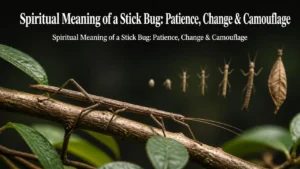
A stick bug can look like nothing more than a small twig moving through leaves. Yet the Spiritual Meaning of a Stick Bug often centers on patience, camouflage, adaptability, and quiet resilience. Its unusual appearance makes it a natural symbol for looking beyond what first meets the eye.In the United States, people often interpret unexpected encounters with animals through personal spirituality.
Nature-based reflection, dreams, and symbolism. A stick bug can therefore feel meaningful when it appears during a period of uncertainty, change, or personal growth. However, there’s an important distinction. A stick bug doesn’t carry one universally agreed spiritual message. Much of its symbolism comes from observing its real behavior and creating a personal metaphor from it.
Quick Answer
In the USA, the spiritual meaning of a stick bug commonly points to patience, adaptability, protection, and staying observant before taking action. Its camouflage can also symbolize hidden strength, personal boundaries, and the wisdom of knowing when to remain unseen.
TL;DR
- Stick bugs commonly symbolize patience, stillness, camouflage, and adaptability.
- Their twig-like bodies represent protection through blending with surroundings.
- Their growth and regeneration can suggest resilience and personal transformation.
- In American spirituality, sightings often invite reflection rather than fixed predictions.
- Cross-cultural meanings vary and shouldn’t be treated as universal beliefs.
- Today, stick bugs can represent quiet confidence, mindfulness, and hidden potential.
What Is a Stick Bug?
A Master of Natural Camouflage
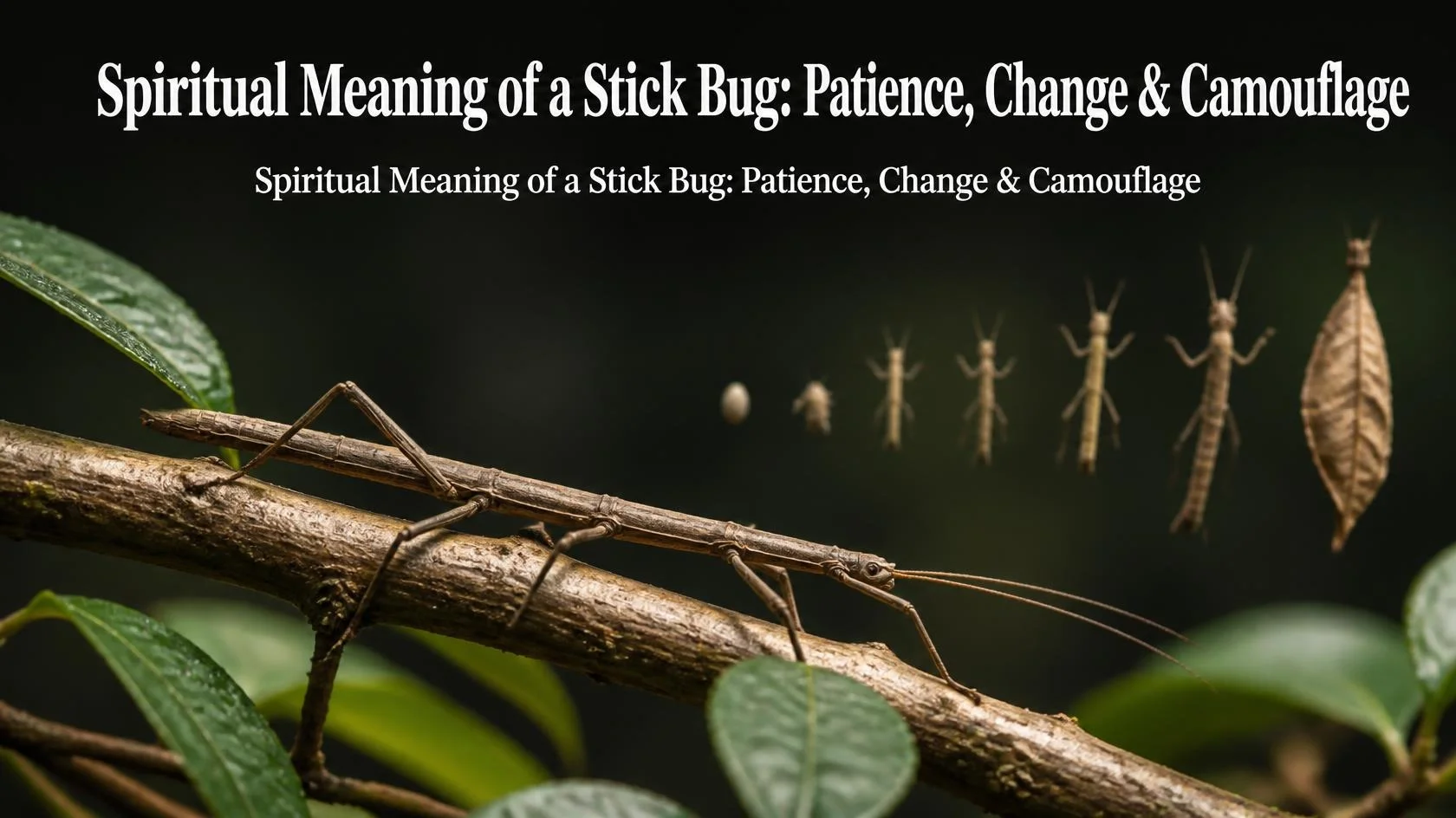
Stick bugs, also called walking sticks or phasmids, belong to the insect order Phasmatodea. They’re famous for resembling twigs, branches, leaves, bark, moss, or other parts of vegetation.
Their camouflage is more than visual. Many species remain extremely still during the day or sway gently like vegetation moving in the wind. This behavior makes them difficult for predators to detect.
That unusual survival strategy explains why the stick bug naturally inspires ideas about discretion, patience, observation, and adaptation.
What Does a Stick Bug Look Like?
Stick bugs vary greatly between species, but many share several recognizable traits:
• Long, narrow bodies resembling small branches
• Thin legs that imitate twigs or stems
• Brown, green, gray, or bark-like coloring
• Slow movements that reduce attention
• Specialized body shapes that improve camouflage
Some species look almost exactly like sticks. Others resemble leaves or moss-covered vegetation. Some even have bright colors that appear only during defensive displays.
Because appearance and behavior work together, the stick bug offers a powerful metaphor for being present without demanding attention.
Stick Bug Symbolism at a Glance
The Main Symbolic Themes
Modern spiritual interpretations tend to return to a small group of themes. These meanings come primarily from the insect’s observable characteristics.
• Patience: Waiting can sometimes be wiser than rushing.
• Camouflage: Protection can come from knowing when to stay unnoticed.
• Adaptability: Changing your approach can help you survive difficult circumstances.
• Observation: Stillness creates opportunities to notice what movement might miss.
• Resilience: Survival can involve recovering after loss or disruption.
• Transformation: Growth happens gradually rather than all at once.
These aren’t scientific predictions or universal spiritual rules. Instead, they’re symbolic interpretations that people use to reflect on their own experiences.
Why Camouflage Matters So Much
Camouflage is perhaps the strongest symbolic feature of the stick bug. Scientists describe phasmids as highly specialized masters of crypsis, meaning they avoid detection by blending into their surroundings. Fossil evidence shows that stick insects had sophisticated defensive adaptations millions of years ago.
Symbolically, that creates an interesting lesson: visibility isn’t always the same as strength.
Sometimes strength means stepping forward. At other times, it means protecting yourself, watching carefully, and choosing the right moment.
Historical Roots of Stick Bug Symbolism
Ancient Roots and the Natural World
There isn’t strong evidence for one ancient civilization assigning a single, universal spiritual meaning to stick bugs. That distinction matters because many modern websites present highly specific ancient claims without solid historical support.
Still, humans have long used animals as metaphors. Creatures that disappear into forests naturally invite ideas about mystery, concealment, survival, and the hidden world.
The stick bug is especially suited to these themes because its body appears almost like part of the landscape.
Evolution Explains the Symbolism
The insect’s actual evolutionary history provides a fascinating foundation for its modern symbolism. Researchers have identified fossil evidence of stick insects with specialized defensive features dating back about 165 million years.
Over time, phasmids developed numerous ways to avoid predators. These include camouflage, remaining motionless, dropping limbs, playing dead, defensive displays, and chemical defenses in some species.
So when modern symbolism describes the stick bug as resilient or adaptable, those ideas have a genuine behavioral foundation.
What Does a Stick Bug Mean in America?
Quiet Strength in American Culture
The United States doesn’t have one official stick bug tradition comparable to major national symbols. Instead, stick bug symbolism usually appears through personal spirituality, nature appreciation, animal symbolism, and modern social media discussions.
American interpretations often focus on qualities such as self-protection, independence, patience, and adapting to change.
For someone experiencing a major transition, seeing a stick bug may become a reminder to avoid unnecessary rushing.
A Symbol of Being Comfortable With Your Own Pace
American culture can place strong value on visibility, achievement, and constant activity. Against that background, the stick bug offers a contrasting image.
It doesn’t need to dominate its environment. It survives by understanding that environment.
That makes it a useful symbol for people who value quiet progress, privacy, observation, or understated confidence.
Common American Interpretations
| Context | Meaning in the USA | Common Associations | Notes |
| Nature encounter | Pause and observe | Patience, awareness | Usually personal rather than traditional |
| Difficult transition | Adapt carefully | Resilience, flexibility | Encourages gradual adjustment |
| Personal boundaries | Stay protected | Privacy, discretion | Camouflage becomes the central metaphor |
| Spiritual reflection | Look beneath appearances | Awareness, intuition | Interpretation depends on personal beliefs |
| Creative symbolism | Quiet individuality | Mystery, subtle strength | Common in art and personal expression |
Spiritual Meaning of Seeing a Stick Bug
When One Appears Unexpectedly
A surprise encounter can feel meaningful, especially when it happens during an emotional or uncertain period. Spiritual interpretations often treat the moment as an invitation to reflect rather than as a guaranteed supernatural message.
Ask yourself what was happening immediately before you noticed it.
Were you considering a major decision? Were you feeling pressured? Were you trying to become less visible? Those circumstances can shape the personal meaning of the encounter.
A Reminder to Slow Down
One of the simplest interpretations is pause before acting.
The stick bug’s stillness can represent a moment when you don’t need an immediate answer. Instead, you may benefit from observing the situation more carefully.
This interpretation doesn’t mean you should avoid action forever. Rather, it emphasizes choosing action deliberately.
A Message About Adaptation
A stick bug survives by fitting into its environment. Symbolically, this can suggest that flexibility isn’t weakness.
Sometimes your circumstances change before you’re ready. In those moments, adaptation can be more useful than resisting every change.
Stick Bug Symbolism and Transformation
Growth Happens in Stages
Stick insects don’t undergo complete metamorphosis like butterflies. Instead, young nymphs resemble smaller versions of adults and grow through repeated molts.
That makes their development symbolically interesting.
Transformation doesn’t always mean becoming an entirely different person overnight. Sometimes it means gradually becoming more capable while retaining your essential nature.
Resilience After Loss
Some stick insects can lose limbs through autotomy, a defensive process in which a body part separates from the body. Certain species can regenerate lost limbs during later growth stages.
This biological ability has naturally inspired modern metaphors about recovery.
Symbolically, the stick bug can therefore represent:
• Recovering after an unexpected setback
• Rebuilding gradually after personal loss
• Accepting that healing takes time
• Finding usefulness in difficult experiences
The important point is that symbolic resilience doesn’t promise that every loss will disappear. Instead, it highlights the possibility of continued growth.
Stick Bug Spiritual Meaning in Different Cultures
Māori Traditions
One well-documented cultural example comes from Māori traditions in New Zealand. Te Ara, the Encyclopedia of New Zealand, records traditions in which insects are connected with Tāne, a major figure associated with the forest.
Some traditions regarded stick insects as relatives or embodiments connected with the forest world. Certain sayings also associated their appearance with sacred places and pregnancy.
This example shows why cultural symbolism deserves care. A tradition should be described within its own cultural setting rather than turned into a universal spiritual rule.
Other Cultural Interpretations
Modern spiritual websites frequently associate stick insects with patience, camouflage, transformation, and endurance across different cultures. However, many of these claims are difficult to verify historically.
Therefore, it’s safer to distinguish documented cultural traditions from modern spiritual interpretations.
The stick bug can inspire similar themes in different places without meaning that every culture historically shared the same belief.
A Broader Nature-Based Theme
Across nature symbolism, camouflage often represents concealment and protection. Stillness can represent awareness. Regeneration can represent recovery.
These themes make the stick bug especially appealing to modern spiritual readers, even when no ancient tradition directly supports a particular interpretation.
Emotional and Psychological Meaning of a Stick Bug
Patience
The stick bug can symbolize the emotional strength required to wait.
Waiting isn’t always passive. Sometimes you’re gathering information, allowing emotions to settle, or watching circumstances develop.
The insect’s stillness creates a useful metaphor for this kind of intentional patience.
Privacy and Boundaries
Camouflage can also represent personal boundaries.
You don’t have to reveal everything about yourself to everyone. Choosing privacy can sometimes protect your energy, relationships, and sense of identity.
However, excessive hiding can create isolation. The healthiest interpretation balances privacy with authentic connection.
Quiet Confidence
A stick bug doesn’t look powerful in the conventional sense. Yet its survival strategy is remarkably effective.
That contrast can symbolize people whose strengths aren’t immediately visible.
You don’t always need to be loud to be capable. Sometimes quiet awareness is its own form of confidence.
Read More: Spiritual Meaning of Cockroaches in Your House: Resilience
Stick Bug Meaning in Dreams
Seeing a Stick Bug in a Dream
Dream symbolism is highly personal, so there’s no single correct interpretation.
Still, a stick bug appearing in a dream may invite reflection about situations where you’re hiding, waiting, adapting, or trying not to attract attention.
Consider the emotional tone of the dream. A peaceful stick bug may suggest calm observation, while a frightening encounter could reflect discomfort with uncertainty or feeling unseen.
Dream Context Matters
Pay attention to what the insect was doing.
• A motionless bug may suggest patience or hesitation.
• A hidden bug may represent something overlooked.
• A moving bug may suggest gradual progress.
• A damaged bug may symbolize vulnerability or recovery.
• A large bug may represent an issue demanding attention.
These interpretations work best as reflective prompts, not fixed predictions.
Stick Bug Meaning in Tattoos, Art, and Decor
Tattoos
A stick bug tattoo can carry a surprisingly subtle message.
Because the insect represents camouflage, patience, and survival, it can appeal to someone who values quiet resilience.
The design can also be visually interesting because artists can emphasize realistic anatomy, botanical surroundings, or the illusion of a twig.
Home Decor and Artwork
Stick bugs fit naturally into botanical and woodland themes.
A realistic illustration can symbolize connection with nature, while a more abstract design can emphasize mystery and transformation.
Their unusual appearance also works well for people who enjoy overlooked creatures rather than traditional animal symbols.
Social Media and Modern Spirituality
Online spiritual communities have expanded interest in animal symbolism. People may share photographs of unexpected encounters and ask what those encounters could mean.
This has made stick bugs more visible as symbolic creatures. However, online interpretations should be treated as personal or modern beliefs unless supported by reliable cultural evidence.
What Does a Stick Bug Mean Spiritually in Christianity?
The Bible Does Not Give It a Specific Symbolic Meaning
The Bible does not identify the stick bug as a specific spiritual symbol. Therefore, claims that Christianity traditionally assigns a fixed meaning to stick bugs should be treated cautiously.
However, Christians may personally reflect on qualities such as patience, humility, stewardship of nature, and careful observation.
Those are broader spiritual themes rather than official teachings about stick insects.
Personal Reflection Versus Doctrine
This distinction is important.
A person may find spiritual inspiration in an animal without claiming that the animal carries a divinely assigned message.
That approach allows personal reflection while respecting established religious teachings.
Is Seeing a Stick Bug Good Luck?
A Positive Interpretation
Some modern spiritual interpretations regard stick bug sightings as encouraging signs. They connect the insect with patience, protection, adaptability, and resilience.
In that sense, seeing one can feel like a positive reminder to stay calm and trust your ability to adjust.
It Isn’t Universally Lucky
There is no universal rule saying that a stick bug brings good luck.
In some traditions, insects can carry different meanings depending on location, circumstance, and cultural history. Even within modern spirituality, interpretations vary.
So instead of asking, “Is this definitely good luck?” a more useful question may be, “What does this encounter make me notice about my life?”
Misunderstandings and Controversies
Not Every Symbolic Claim Is Ancient
One common problem with animal symbolism is presenting modern interpretations as ancient facts.
For stick bugs, many online claims about specific Native American, Celtic, Christian, African, or Asian beliefs lack clear historical documentation. Readers should distinguish between contemporary spiritual writing and established cultural records.
Don’t Generalize Native Traditions
Native American cultures include many distinct nations and traditions. There isn’t one universal Native American belief about every animal.
Therefore, broad statements about what “Native Americans believed” can be misleading.
A respectful approach identifies a specific documented tradition when evidence exists. Otherwise, it’s better to describe the interpretation as a modern spiritual idea.
Camouflage Doesn’t Mean Deception
The stick bug’s disguise is sometimes interpreted negatively as deception or dishonesty.
BiologicallySymbolically, you can interpret camouflage as caution without assuming that hiding always represents dishonesty.
How Stick Bug Symbolism Has Changed Over Time
From Survival Strategy to Spiritual Metaphor
The insect’s biological traits haven’t changed simply because humans interpret them differently.
What has changed is the way people describe those traits.
Today, camouflage can become a metaphor for privacy. Stillness can represent mindfulness. Regeneration can suggest resilience. Adaptation can represent personal growth.
From Hidden Creature to Symbol of Awareness
Modern nature spirituality often encourages people to notice overlooked animals.
The stick bug fits this idea perfectly. It’s easy to miss until you actually slow down and look.
That makes its symbolism especially relevant in a culture where people often feel pressured to move quickly.
How to Apply the Stick Bug’s Symbolism to Your Life
Use It as a Reflection Tool
You don’t have to believe that every animal encounter contains a supernatural message.
Instead, use the stick bug as a simple reflection tool.
Ask yourself:
• Where am I rushing when patience would help?
• What situation requires greater flexibility?
• Am I hiding because I need protection or fear attention?
• What have I overlooked because I wasn’t paying attention?
• Where might quiet progress be more valuable than quick results?
These questions turn symbolism into something practical without requiring a specific spiritual belief.
Know When to Blend In and When to Stand Out
Perhaps the most useful lesson is balance.
There are moments when blending in protects you. There are also moments when staying invisible prevents you from expressing yourself.
The stick bug can therefore represent discernment: knowing when silence helps and when your voice matters.
FAQs
What does it mean when you see a stick bug?
A stick bug sighting is commonly interpreted as a symbol of patience, adaptability, protection, and observation. However, there isn’t one universal spiritual meaning, so personal circumstances matter.
Is a stick bug a good spiritual sign?
Many modern spiritual interpretations view it positively. Its camouflage and resilience can symbolize protection, quiet strength, and the ability to adapt.
What does a stick bug symbolize in dreams?
A stick bug in a dream may symbolize hiding, patience, vulnerability, or adapting to change. The meaning depends heavily on the dream’s setting and your emotions.
Does the Bible mention stick bugs?
The Bible doesn’t specifically identify stick bugs or assign them a spiritual meaning. Christians may still use nature as a source of personal reflection, but that shouldn’t be confused with biblical doctrine.
What does a stick bug symbolize spiritually?
The most common modern interpretation connects it with patience, stillness, camouflage, adaptability, resilience, and transformation. These meanings largely come from its unusual behavior and survival abilities.
Are stick bugs associated with good luck?
Some modern spiritual traditions interpret encounters positively, while others emphasize caution and awareness. There is no universal belief that stick bugs always represent good or bad luck.
Conclusion
The Spiritual Meaning of a Stick Bug is largely built around what this remarkable insect does naturally. Its camouflage suggests protection and discretion, its stillness suggests patience, and its ability to adapt suggests resilience through changing circumstances.For an American reader, a stick bug encounter can become a quiet reminder to slow down and observe. It may encourage you to protect your boundaries, adapt without losing yourself, and recognize strength that isn’t immediately visible.
Ultimately, the most meaningful interpretation may be personal. The next time a stick bug appears almost invisibly among the leaves, take a moment to notice it. Sometimes the smallest creatures can inspire us to see familiar parts of our own lives differently.