Discover what spiritual candles symbolize, from color meanings and ancient roots to prayer, meditation, rituals, holidays, and modern American use.
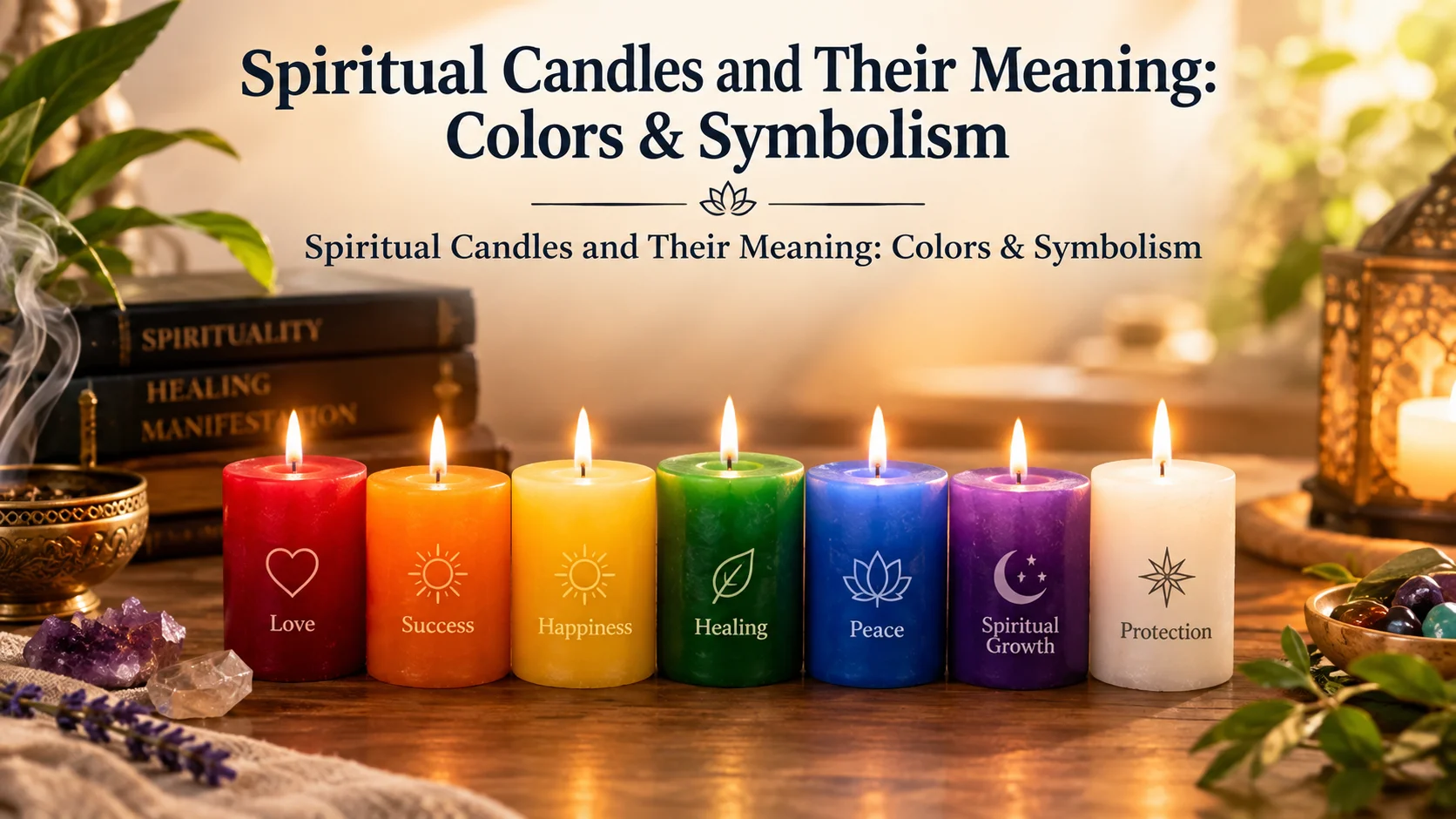
Colorful spiritual candles representing different meanings and intentions. Candlelight can turn an ordinary moment into a meaningful ritual.Candles have a simple physical form, yet they can carry powerful symbolic meaning. Spiritual Candles and Their Meaning often centers on light, intention, prayer, protection, remembrance, love, and personal transformation.In the United States, candles appear in many settings. People light them during religious services, meditation, memorials, holidays, personal rituals, and quiet moments at home.
Their meaning can change dramatically depending on the color, setting, and purpose.However, candle symbolism doesn’t have one universal rulebook. A white candle may suggest purity in one tradition and remembrance in another. Likewise, red can represent love, courage, sacrifice, or celebration.Understanding that flexibility makes candle symbolism more interesting. Instead of treating every color as a fixed spiritual code, it helps to view candles as visual language shaped by history, culture, faith, and personal intention.
Quick Answer
Spiritual Candles and Their Meaning in the United States commonly centers on light, hope, protection, remembrance, prayer, love, and personal intention. Different colors add symbolic layers, but their meanings vary between religious and spiritual traditions.
TL;DR
• Candles commonly symbolize light, hope, remembrance, prayer, and spiritual focus.
• White often represents peace, purity, protection, or clarity.
• Red commonly suggests love, courage, passion, strength, or sacrifice.
• Blue is frequently connected with peace, wisdom, truth, and calm.
• Green often symbolizes growth, abundance, renewal, or nature.
• Context matters because candle meanings differ across traditions.
What Do Spiritual Candles Symbolize?
Candles symbolize more than illumination. Their flame creates a visible connection between an inner thought and an outward action.
For many Americans, lighting a candle marks a deliberate pause. It can signal prayer, reflection, remembrance, celebration, or a personal intention.
Light and Hope
The most widespread candle symbol is light overcoming darkness. This idea is easy to understand because light changes a dark room immediately.
As a result, candlelight often represents hope during difficult periods. A single flame can also suggest guidance, awareness, or the possibility of a new beginning.
Intention and Focus
A candle can also give an abstract intention a physical form. Someone may light one while praying for peace, remembering someone who died, or reflecting on a personal goal.
Modern spiritual practices frequently use this quality. The candle becomes a visual reminder of what the person wants to focus on.
Common Symbolic Themes
• Light represents hope, awareness, and guidance.
• Flame represents energy, transformation, and spiritual attention.
• Wax represents change because it melts and takes new forms.
• A burning wick can represent endurance and continued intention.
• Extinguishing a flame can symbolize completion, transition, or closure.
Spiritual Candle Color Meanings
Color adds another layer to candle symbolism. However, color meanings aren’t universal laws. They developed through different religious, cultural, artistic, and spiritual traditions.
Modern spiritual guides commonly associate white with purity, red with passion, blue with peace, and green with growth. These associations remain popular in contemporary American spiritual practices.
White Candles
White is one of the most flexible candle colors. It often represents purity, peace, clarity, protection, and spiritual light.
In Christian settings, white can also connect with celebration, holiness, and resurrection. Outside formal religion, people often choose white when they want a simple symbol of peace or a fresh start.
Red Candles
Red naturally attracts attention. Consequently, it often symbolizes love, passion, courage, strength, energy, and determination.
In spiritual settings, red may express romantic intention. In religious contexts, however, it can carry very different meanings, including sacrifice or sacred devotion.
Blue Candles
Blue commonly suggests peace, wisdom, truth, calmness, and emotional balance.
For someone creating a quiet meditation space, blue can visually reinforce a peaceful mood. Its association with sky and water also makes it easy to connect with openness and serenity.
Green Candles
Green is strongly associated with nature and renewal. Therefore, it commonly symbolizes growth, abundance, prosperity, fertility, balance, and fresh opportunities.
In modern spiritual practices, green may appear in rituals focused on prosperity or personal development. Yet its meaning can shift according to the tradition involved.
Purple Candles
Purple often carries associations with spiritual awareness, intuition, mystery, dignity, and transformation.
Its historical connection with royalty also gives it a sense of importance. In some Christian traditions, purple has specific liturgical meanings connected with seasons such as Advent and Lent.
Black Candles
Black can seem negative because American culture often associates darkness with danger. Spiritual traditions, however, may use black symbolically for protection, boundaries, endings, grounding, or release.
That doesn’t mean black automatically represents evil. Its interpretation depends heavily on the practice and context.
Yellow and Orange Candles
Yellow often suggests clarity, confidence, communication, optimism, and mental energy. Orange commonly represents creativity, enthusiasm, motivation, and change.
These warm colors can also create a lively visual atmosphere. Consequently, they’re often chosen when someone wants to emphasize movement or positive energy.
What Is the Historical Meaning of Candles?
The symbolic history of candles begins with humanity’s relationship with fire and artificial light. However, candles themselves developed gradually rather than appearing suddenly in one ancient civilization.
Before candles became common, people relied heavily on lamps, torches, and other sources of flame. Ancient Egyptian oil lamps, for example, used plant-fiber or linen wicks in oil-filled vessels. The Metropolitan Museum of Art preserves examples from the Roman-period Egypt.
Ancient Roots
Ancient cultures often connected fire with divine presence, offerings, ceremony, and protection. However, historians should distinguish between oil lamps and true candles.
Oil lamps used liquid fuel. Candles use a solid fuel surrounding a wick. Both produced light, but they developed differently.
Candles became important in the Roman world, while surviving candle traditions also developed elsewhere. China, the Middle East, Europe, and other regions developed distinct lighting technologies.
Medieval Europe
During the Middle Ages, beeswax became especially important for candle making. Beeswax was valuable and was used for candles, furniture polish, and other purposes.
Candles also became deeply connected with Christian worship. Large ceremonial candles could represent sacred light and were incorporated into processions and church rituals.
A medieval candlestick in The Metropolitan Museum’s collection shows how candles functioned in both religious and domestic settings.
From Sacred Object to Household Item
Over time, candle making became a skilled trade. Improvements in materials and manufacturing eventually made candles more affordable.
As electricity spread, candles lost much of their practical role as everyday lighting. Yet their symbolic role survived.
That shift is important. Today, most Americans don’t light candles because they need light. They light them because the act itself means something.
What Does Candlelight Mean in American Culture?
In the United States, candlelight has become a flexible cultural symbol. It appears in religious ceremonies, holidays, memorial events, weddings, protests, and private homes.
This flexibility reflects America’s religious and cultural diversity. The same flame can carry very different meanings for different communities.
Memorial and Remembrance
A candle often represents memory after someone’s death. People may light one at a vigil, memorial service, anniversary, or private remembrance.
American public life has repeatedly used candlelight during commemorations. For example, the National Park Service documents candlelight vigils connected with memorial events at Kent State and after September 11, 2001.
Religious Freedom and Identity
Candles also appear in American celebrations of religious identity. Hanukkah is a particularly visible example.
The Library of Congress notes that the National Menorah lighting began in Washington, D.C., in 1979. President Jimmy Carter participated in that first National Menorah Lighting near the White House.
This history shows how candlelight can become part of public American culture while retaining its religious roots.
Everyday American Life
Today, candles also appear in ordinary homes. People use them during meditation, prayer, birthdays, dinners, self-reflection, and relaxation.
Their meaning doesn’t always need to be religious. Sometimes the candle simply marks a moment that deserves attention.
Spiritual Candles in Christianity, Judaism, and Other Traditions
Candle symbolism crosses religious boundaries, but each tradition gives it its own meaning. It’s important not to combine these meanings into one universal system.
Christianity
Candles have a long history in Christian worship. They can symbolize Christ as light, prayer, devotion, remembrance, or sacred presence.
The Paschal candle, for example, plays an important role in the Easter Vigil. The Metropolitan Museum describes its use in a ceremony connected with the Resurrection.
Advent candles also give light a structured meaning. Each candle can mark part of a spiritual season leading toward Christmas.
Judaism
Candle lighting has a particularly important place in Jewish life. Hanukkah uses a nine-branched Hanukkah lamp, with the additional shamash used to light the other candles.
The eight holiday lights recall the traditional story of the oil that remained lit for eight days. In America, Hanukkah candle lighting has also become a public expression of Jewish identity and religious freedom.
Kwanzaa
Kwanzaa provides another distinctive American example. Created in 1966, the holiday uses a kinara, or candleholder, with seven candles representing seven principles.
The Smithsonian explains that each day highlights a principle through candle lighting and related activities.
Other Spiritual Practices
Candles also appear in Buddhist, Hindu, Pagan, folk, and personal spiritual practices. However, their meanings differ widely.
For that reason, it’s better to ask, “What does this candle mean in this tradition?” rather than assuming every candle has the same spiritual message.
What Do Different Candle Colors Mean Spiritually?
The following table provides a practical overview of common modern associations. These are broad symbolic patterns, not universal religious rules.
| Candle Color | Common Symbolic Meaning | Common Associations | Important Context |
| White | Peace, purity, clarity | Prayer, protection, new beginnings | Often highly versatile |
| Red | Love, courage, passion | Romance, strength, vitality | Can have religious meanings |
| Blue | Peace, truth, wisdom | Meditation, calm, reflection | Often linked with water or sky |
| Green | Growth, abundance, renewal | Prosperity, nature, balance | Meanings vary by practice |
| Purple | Intuition, spirituality, transformation | Meditation, reflection, mystery | Also has Christian liturgical uses |
| Black | Protection, endings, grounding | Boundaries, release, transition | Not automatically negative |
The table is useful for orientation, but personal meaning still matters. A candle’s setting, accompanying symbols, words, prayers, and rituals can change its interpretation.
What Is the Psychological Meaning of Lighting a Candle?
Candle rituals can feel powerful partly because they combine several senses. You see the flame, notice its movement, and often smell the wax or fragrance.
That sensory combination can make a simple action feel special. The ritual also creates a clear beginning and ending.
The Flame as a Focus Point
A steady flame gives the eyes something simple to observe. During quiet reflection, this can help create a sense of stillness.
People have used candle gazing and candle meditation for this reason. The symbolic meaning comes from the tradition, while the physical flame provides a concrete object for attention.
Ritual Creates Structure
Lighting a candle can also mark a transition.
For example, someone might light a candle before journaling each evening. After repeated use, the action can become a personal signal that it’s time to slow down.
Symbolic Emotional Associations
• White can evoke calmness and a sense of beginning again.
• Red can express intensity, desire, courage, or determination.
• Blue can suggest quietness, trust, and emotional steadiness.
• Green can evoke renewal, nature, and forward movement.
• Purple can create associations with mystery and inner reflection.
• Candlelight itself often creates warmth and intimacy.
These responses aren’t identical for everyone. Personal memories and cultural background strongly influence emotional associations.
Read More: Spiritual Meaning of Earwig in House: Signs & Symbolism
What Do Spiritual Candles Mean in Meditation and Prayer?
Candles can help mark a quiet space for meditation or prayer. Their symbolic role depends on the person’s beliefs and chosen tradition.
For some people, the flame represents divine light. For others, it simply provides a peaceful visual focus.
Using a Candle for Prayer
A person might light a candle before prayer as a physical expression of intention. The flame can represent hope, remembrance, gratitude, or a request.
In some traditions, the candle continues burning after the person leaves. This creates a symbolic sense that the prayer continues beyond the moment.
Using a Candle for Meditation
Meditation doesn’t require a candle. Still, some people find a flame useful as a gentle visual anchor.
A simple practice might involve sitting quietly and watching the flame without trying to interpret every movement. The goal can simply be attention and stillness.
Personal Rituals
Modern Americans also create private rituals that aren’t connected to formal religion. Someone may light a candle while writing intentions, reflecting on a life change, or beginning a new chapter.
This is one reason candle symbolism remains adaptable.
What Do Spiritual Candles Mean in Modern Homes?
Candles have moved far beyond churches and formal ceremonies. They now appear in bedrooms, living rooms, bathrooms, meditation spaces, and personal altars.
In modern home decor, the candle can combine beauty with symbolism.
Decor and Atmosphere
A candle can make a room feel warmer and more intimate. Color, container shape, flame size, and scent all influence that atmosphere.
However, decorative use doesn’t erase symbolic meaning. A person might choose a white candle because it matches a room while also appreciating its peaceful associations.
Social Media and Personal Identity
Candles also appear frequently in photographs of journals, crystals, books, plants, meditation spaces, and personal altars.
These images can communicate a particular lifestyle. The candle often signals calm, reflection, spirituality, self-care, or intentional living.
Holidays and Celebrations
Candles remain especially visible during American holidays and ceremonies. They appear during Christmas, Hanukkah, Kwanzaa, birthdays, weddings, memorials, and other gatherings.
The Smithsonian notes that candlelight plays a major role in several American holiday traditions.
What Does It Mean When a Candle Burns in a Spiritual Ritual?
Many spiritual traditions pay attention to a candle while it burns. People may notice the flame, wax, smoke, or how quickly the candle disappears.
However, interpretations differ considerably. A flame that seems unusual isn’t automatically a supernatural message.
Flame Interpretations
Some spiritual practitioners assign symbolic meanings to flame behavior. A high flame may be interpreted as strong energy or focused intention.
Others see flame movement as a normal result of airflow, wick condition, wax composition, and surrounding temperature.
Wax and Smoke
Wax patterns can become visually meaningful during rituals. People may interpret shapes as symbolic messages.
Yet these interpretations are personal or tradition-specific. They shouldn’t be treated as universal facts.
A Balanced Perspective
You can appreciate the symbolism without assuming every physical change has a hidden meaning.
Sometimes a candle is simply reacting to its environment. The spiritual value may come from what the ritual means to the person rather than from the candle’s physical behavior.
What Are Candle Colors Used for in Spiritual Practices?
Modern spiritual traditions often connect particular colors with specific intentions. These systems can be found in contemporary ritual practices, meditation, folk spirituality, and forms of candle magic.
Common Intention Pairings
• White for peace, cleansing, protection, or spiritual clarity.
• Red for passion, courage, love, or determination.
• Pink for affection, friendship, compassion, or gentle love.
• Green for growth, prosperity, balance, or renewal.
• Blue for peace, communication, truth, or wisdom.
• Purple for intuition, reflection, spirituality, or transformation.
• Black for grounding, boundaries, release, or protection.
These associations are best understood as symbolic tools. They don’t have one agreed meaning across every spiritual tradition.
Can Candle Symbolism Be Misunderstood?
Yes. The biggest misunderstanding is assuming that a candle color has one fixed meaning everywhere.
Symbols work through context. A red candle on a romantic dinner table doesn’t communicate exactly the same thing as a red candle in a church or memorial ceremony.
Color Isn’t a Universal Code
Different communities developed different symbolic systems. Even within one religion, practices can vary by denomination, region, and historical period.
Therefore, context should always come before interpretation.
Black Doesn’t Always Mean Evil
Black is especially prone to misunderstanding. Modern Western culture sometimes links black with death, danger, or darkness.
Yet spiritual practitioners may use black for protection, grounding, endings, or the symbolic removal of unwanted influences. The color itself isn’t inherently good or bad.
Avoid Treating Symbolism as Guaranteed Results
Some modern spiritual sources describe candles as tools for attracting specific outcomes. Those claims belong to particular belief systems.
A respectful approach distinguishes symbolic intention from proven physical effects. A candle can help someone express a belief or focus attention without guaranteeing an external result.
How Has Candle Symbolism Changed Over Time?
Candle symbolism has never remained completely fixed. Its meaning has shifted as technology, religion, culture, and daily life changed.
From Necessity to Symbol
For centuries, candles were practical sources of light. Their spiritual meaning developed alongside their everyday usefulness.
Electric lighting changed that relationship. Once candles stopped being necessary for most households, their symbolic and decorative roles became more prominent.
From Public Ritual to Personal Practice
Candles once belonged strongly to formal ceremonies and religious institutions. Today, people also use them privately.
That change reflects a broader American interest in personal spirituality. Someone can create a meaningful ritual without belonging to a formal religious institution.
The Modern Revival
In 2025 and 2026, spiritual candle practices remain visible across online spirituality, meditation, personal ritual, and home decor. Contemporary guides continue to describe
The modern candle therefore occupies several worlds at once. It’s a household object, decorative item, religious symbol, memorial tool, and personal ritual object.
How Should You Choose a Spiritual Candle?
Choosing a candle doesn’t have to be complicated. Start with the meaning you want the ritual to express.
Consider Your Intention
First, decide what the candle represents for you. You might choose peace, remembrance, love, courage, gratitude, renewal, or spiritual reflection.
Then select a color that supports that idea.
Consider the Tradition
If you’re participating in a religious ceremony, follow that tradition’s established meaning rather than a generic color chart.
For personal practice, you have more freedom. Your own associations can become part of the symbolism.
Consider the Setting
A candle used during meditation may have a different purpose from one used at a wedding or memorial.
Ask three simple questions:
• What am I trying to express?
• What does this color mean in my chosen tradition?
• What does this candle personally represent to me?
Those questions usually provide enough direction.
FAQs About Spiritual Candles and Their Meaning
What does lighting a candle symbolize?
Lighting a candle commonly symbolizes hope, prayer, remembrance, guidance, or spiritual attention. The exact meaning depends on the tradition and situation.
What color candle is best for spiritual protection?
White and black are both commonly associated with protection in modern spiritual practices. However, different traditions assign different meanings to each color.
What does a white candle mean spiritually?
A white candle often represents peace, purity, clarity, protection, or spiritual light. In Christian contexts, it can also carry meanings connected with holiness and resurrection.
What does a red candle mean spiritually?
Red commonly represents love, passion, courage, strength, and energy. In religious settings, however, red may have meanings involving sacrifice, sacred devotion, or specific ceremonies.
What does a blue candle mean spiritually?
Blue is often associated with peace, wisdom, truth, calmness, and reflection. Its symbolism can also connect with water, sky, and emotional balance.
What does a black candle symbolize?
Black candles may symbolize protection, grounding, boundaries, endings, or release. They aren’t automatically symbols of evil, and their meaning depends strongly on context.
Does candle color really have spiritual power?
Candle colors have spiritual meaning within particular traditions and belief systems. Whether someone considers that meaning spiritually powerful is ultimately a matter of personal or religious belief.
Conclusion
Candles have survived centuries of cultural change because their symbolism remains remarkably flexible. Their flame can represent light, hope, prayer, remembrance, protection, love, growth, or transformation, depending on the setting.In the United States, Spiritual Candles and Their Meaning can be found in churches, homes, memorials, holidays, meditation spaces, and personal rituals. Their colors add another layer, but no single color chart can explain every tradition.