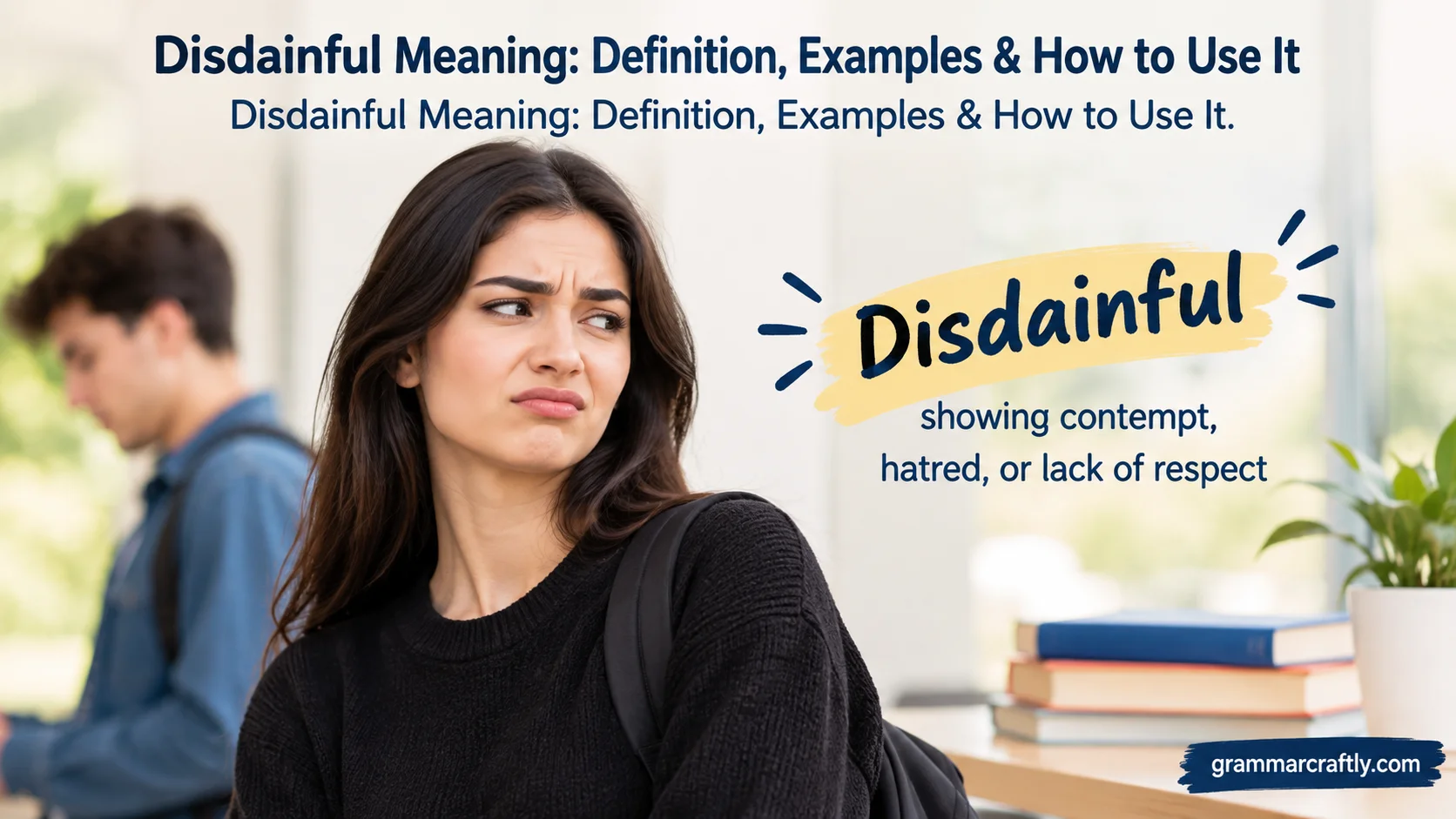
When someone acts as though another person or idea is beneath their attention or respect, their attitude may be described as disdainful. The word often suggests more than simple dislike because it can carry a sense of superiority, scorn, or deliberate disregard. In American English, you’ll commonly see it used to describe a look, tone, attitude, comment, or response.
A person might give a disdainful glance, make a disdainful remark, or sound disdainful when rejecting someone’s opinion.Understanding this word can help you recognize the emotional message behind someone’s behavior. It also helps you choose the right word when you want to describe disrespect without simply saying someone is rude.
Quick Answer
Disdainful meaning refers to showing contempt, scorn, or a lack of respect toward someone or something considered unworthy. In everyday American English, it often describes a superior, dismissive, or scornful attitude.
TL;DR
- Disdainful means showing contempt or strong lack of respect.
- It often suggests that someone feels superior to others.
- A disdainful look can communicate scorn without words.
- Common synonyms include scornful, contemptuous, haughty, and supercilious.
- Its opposite can be respectful, admiring, humble, or appreciative.
What Does Disdainful Mean?
Simple Definition
Disdainful is an adjective used for someone who shows disdain. In simple terms, it describes an attitude that says, “You or this thing isn’t worthy of my respect or attention.”
For example, if someone rolls their eyes while another person speaks, that reaction may appear disdainful. The behavior communicates more than disagreement. It can suggest that the speaker considers the other person’s ideas foolish, inferior, or unimportant.
The word can describe people, expressions, voices, actions, and attitudes.
• A disdainful glance can show silent contempt.
• A disdainful tone can make disagreement sound insulting.
• A disdainful attitude can suggest feelings of superiority.
• A disdainful response may dismiss someone’s opinion without consideration.
What Is the Origin of Disdainful?
From Disdain to Disdainful
The word disdainful developed from the older word disdain. Historical records place disdain in Middle English, with roots connected to Anglo-French and Latin.
The English adjective appeared around the 16th century. It was formed from disdain with the suffix -ful, meaning “full of” or “characterized by.”
So, the basic idea is straightforward: something disdainful is full of or expresses disdain.
How the Meaning Developed
Over time, the word became strongly connected with contempt, superiority, and scorn. Its meaning has remained fairly stable rather than undergoing a dramatic change.
Today, it still describes behavior that communicates that someone or something isn’t worthy of respect or attention.
How Is Disdainful Used in a Sentence?
Common Sentence Patterns
The most common structure uses disdainful of when describing what someone looks down upon.
For example:
She was disdainful of people who ignored the rules.
You can also use the word before a noun to describe an expression or behavior.
He gave his coworker a disdainful glance.
Another common pattern describes a person’s overall manner.
Her disdainful attitude made the conversation uncomfortable.
The word usually carries a negative meaning. However, context can sometimes soften it, especially when someone has a strong but justified dislike for something they consider harmful or foolish.
More Examples
• The manager gave a disdainful smile after hearing the suggestion.
• He sounded disdainful when discussing the new policy.
• She was openly disdainful of their business practices.
• His disdainful expression made his feelings obvious.
• The critic took a disdainful view of the performance.
What Are the Synonyms of Disdainful?
Common Alternatives
Several English words have meanings close to disdainful. However, each one adds a slightly different shade of meaning.
| Word | Meaning | Common Feeling |
| Scornful | Showing strong contempt | Open rejection |
| Contemptuous | Showing deep disrespect | Strong disapproval |
| Haughty | Acting superior to others | Pride and superiority |
| Supercilious | Acting as though others are inferior | Arrogance |
| Dismissive | Treating something as unimportant | Indifference or rejection |
These words can overlap, but they’re not always interchangeable. For example, dismissive can describe someone who simply refuses to take an idea seriously. Disdainful usually adds a stronger sense of contempt or superiority.
Disdainful vs. Contemptuous: What’s the Difference?
A Small but Important Distinction
Disdainful and contemptuous are very close in meaning. Both can describe someone who views another person or thing as unworthy.
However, disdainful often highlights the attitude or manner being displayed. A disdainful look, voice, or gesture can reveal someone’s feelings.
Contemptuous can sound stronger. It often emphasizes deep disrespect or a strong judgment against the person or thing involved.
For example:
She gave him a disdainful look.
This focuses on her visible attitude.
Her contemptuous remarks shocked everyone.
Here, the word emphasizes the harshness of her remarks.
Disdainful vs. Scornful: Are They the Same?
Understanding the Difference
The words disdainful and scornful are often interchangeable. Both can describe an attitude that rejects something as beneath consideration.
Still, scornful can sound more openly mocking or derisive. Someone who laughs at another person’s efforts may be scornful.
Someone who simply looks down on those efforts may be disdainful.
For example, a person can silently give a disdainful glance without saying anything. A scornful response may be more openly mocking.
What Is the Opposite of Disdainful?
Positive Alternatives
The opposite of disdainful is generally an attitude of respect, admiration, or appreciation.
Depending on the situation, several words can work:
• Respectful means showing regard for someone.
• Humble means avoiding an attitude of superiority.
• Appreciative means recognizing someone’s value.
• Admiring means holding someone or something in high regard.
• Courteous means showing good manners and consideration.
The best antonym depends on the sentence. Respectful is usually the simplest opposite.
For example:
She was disdainful toward her coworkers.
The opposite would be:
She was respectful toward her coworkers.
What Does a Disdainful Look Mean?
Reading the Expression
A disdainful look usually communicates disapproval mixed with contempt or superiority. It can appear through facial expressions, eye movements, posture, or tone.
For example, someone may raise an eyebrow, look away, smirk, or give another person a cold stare. None of these gestures automatically proves disdain, though.
Context matters.
A person might look away because they’re distracted rather than disrespectful. Therefore, calling an expression disdainful usually means the surrounding situation suggests contempt or disregard.
Common Signals
• Eye-rolling can suggest dismissiveness or contempt.
• A raised eyebrow may signal doubt or superiority.
• A smirk can communicate mocking disapproval.
• Looking someone up and down may suggest judgment.
• A cold tone can reinforce a disdainful expression.
What Emotions Are Connected With Disdainful Behavior?
Emotional Meaning
Disdainful behavior is usually associated with contempt, superiority, irritation, rejection, and disapproval. The person displaying it may believe they have little reason to respect the target.
However, the emotion isn’t always simple. Disdain can sometimes develop from disappointment, frustration, or repeated negative experiences.
For example, someone might become disdainful of dishonest behavior after experiencing it repeatedly. In that case, the person’s attitude reflects strong disapproval rather than simple personal dislike.
Still, the word itself describes the outward attitude rather than proving why someone feels that way.
Social Impact
A disdainful attitude can quickly create distance between people. Others may feel judged, embarrassed, ignored, or belittled.
That effect explains why the word often appears in discussions about relationships, workplaces, public debates, and social interactions.
Read More: https://grammarsquares.com/challenge-or-challange/
Is Disdainful Always Negative?
Usually, But Context Matters
The word disdainful normally has a negative meaning because it describes contempt or a lack of respect.
However, the thing being disdained can sometimes be viewed negatively by the speaker and the audience. For instance, someone may be described as disdainful of dishonesty.
In that sentence, the attitude toward dishonesty may seem understandable or even admirable. The word still describes the person’s scorn, but it doesn’t automatically tell you whether their target deserves that scorn.
This distinction is useful because disdainful describes an attitude, not necessarily whether the attitude is justified.
How Is Disdainful Used in American English?
Everyday Communication
In the United States, disdainful is more common in formal, descriptive, or written English than in casual conversation.
People may say “She was rude” during everyday speech. A writer, journalist, teacher, or commentator might instead describe her behavior as “disdainful.”
The word is especially useful when ordinary “rude” doesn’t fully capture the situation.
For example, someone can be rude by interrupting you. Someone can be disdainful by interrupting while clearly acting as though your opinion doesn’t matter.
Common American Contexts
• Workplace disagreements
• Political commentary
• Reviews and criticism
• Personal relationships
• Social discussions
• Literary descriptions
• News and opinion writing
How Does Disdainful Differ From Arrogant?
Arrogance vs. Disdain
Arrogant describes an inflated sense of one’s own importance or abilities. Disdainful describes contempt toward someone or something considered inferior or unworthy.
A person can be arrogant without openly showing disdain. Likewise, someone can behave disdainfully in a particular situation without generally being arrogant.
Consider these examples:
He was arrogant about his intelligence.
This focuses on his inflated view of himself.
He was disdainful of people who disagreed with him.
This focuses on how he treated others.
The two qualities often appear together, but they aren’t identical.
What Are Common Misunderstandings About Disdainful?
Disdainful Doesn’t Simply Mean Angry
Anger and disdain are different emotions. An angry person may strongly dislike what happened but still respect the other person.
A disdainful person tends to communicate that the target isn’t worthy of serious consideration.
For example:
“I’m angry that you broke the agreement.”
This expresses anger.
“I don’t even consider your explanation worth hearing.”
This may express disdain.
Disdainful Doesn’t Always Mean Hatred
Disdain doesn’t necessarily mean someone hates another person. It can instead involve emotional distance, contempt, or a belief that something isn’t worth attention.
Someone may disdain a certain style of music without hating the people who enjoy it.
How Has the Meaning of Disdainful Changed Over Time?
A Stable Core Meaning
The word’s central meaning has remained remarkably consistent. Its historical roots connect to ideas of scorn and regarding something as beneath consideration.
Earlier English could use related forms in contexts involving social status, honor, and personal worth. Today, the word remains connected to those ideas but appears across a much wider range of situations.
Modern speakers may use it for attitudes toward politics, entertainment, workplaces, social behavior, ideas, products, or personal choices.
Modern Digital Communication
Online communication has also created new ways to display disdain. A person may communicate contempt through a short reply, sarcastic comment, reaction image, or dismissive post.
However, digital messages lack facial expressions and vocal tone. Therefore, readers may interpret a comment as more disdainful than the writer intended.
Why Understanding Disdainful Matters
Choosing the Right Word
Knowing the difference between related words makes your writing more precise. Instead of calling every negative reaction “rude,” you can explain exactly what happened.
Use disdainful when someone appears to look down on a person, idea, or thing. Use dismissive when they treat it as unimportant, and use scornful when their reaction includes obvious contempt or ridicule.
This precision helps readers understand the emotional meaning behind your description.
Better Communication
Recognizing disdain can also help you interpret difficult conversations. A cold expression doesn’t always prove contempt, but repeated dismissive behavior can reveal a pattern.
Understanding the word gives you a useful way to describe that pattern without automatically assuming someone’s motives.
FAQs
What does disdainful mean in simple words?
Disdainful means showing that you think someone or something is beneath your respect or attention. It often suggests contempt, scorn, or superiority.
Is disdainful a positive or negative word?
Disdainful is normally negative because it describes contempt or disrespect. However, the thing being rejected may itself be viewed negatively, depending on the context.
What is a synonym for disdainful?
Common synonyms include scornful, contemptuous, haughty, supercilious, arrogant, and dismissive. The best choice depends on the exact situation.
What is the opposite of disdainful?
The most common opposite is respectful. Other possibilities include admiring, appreciative, humble, and approving.
What does a disdainful look mean?
A disdainful look usually communicates contempt, disapproval, or a sense of superiority. Facial expressions such as an eye-roll or cold stare can sometimes convey this attitude.
Is disdainful the same as arrogant?
No. Arrogant describes an exaggerated sense of one’s own importance. Disdainful describes showing contempt toward someone or something considered inferior or unworthy.
Conclusion
The disdainful meaning centers on contempt, scorn, and a lack of respect. It describes an attitude that suggests someone or something isn’t worthy of attention, consideration, or admiration.
In American English, the word works especially well when describing a look, tone, response, or attitude that goes beyond ordinary dislike. Once you understand its connection to superiority and contempt, you’ll be able to recognize and use the word with much greater precision.














1 thought on “Disdainful Meaning: Definition, Examples & How to Use It”