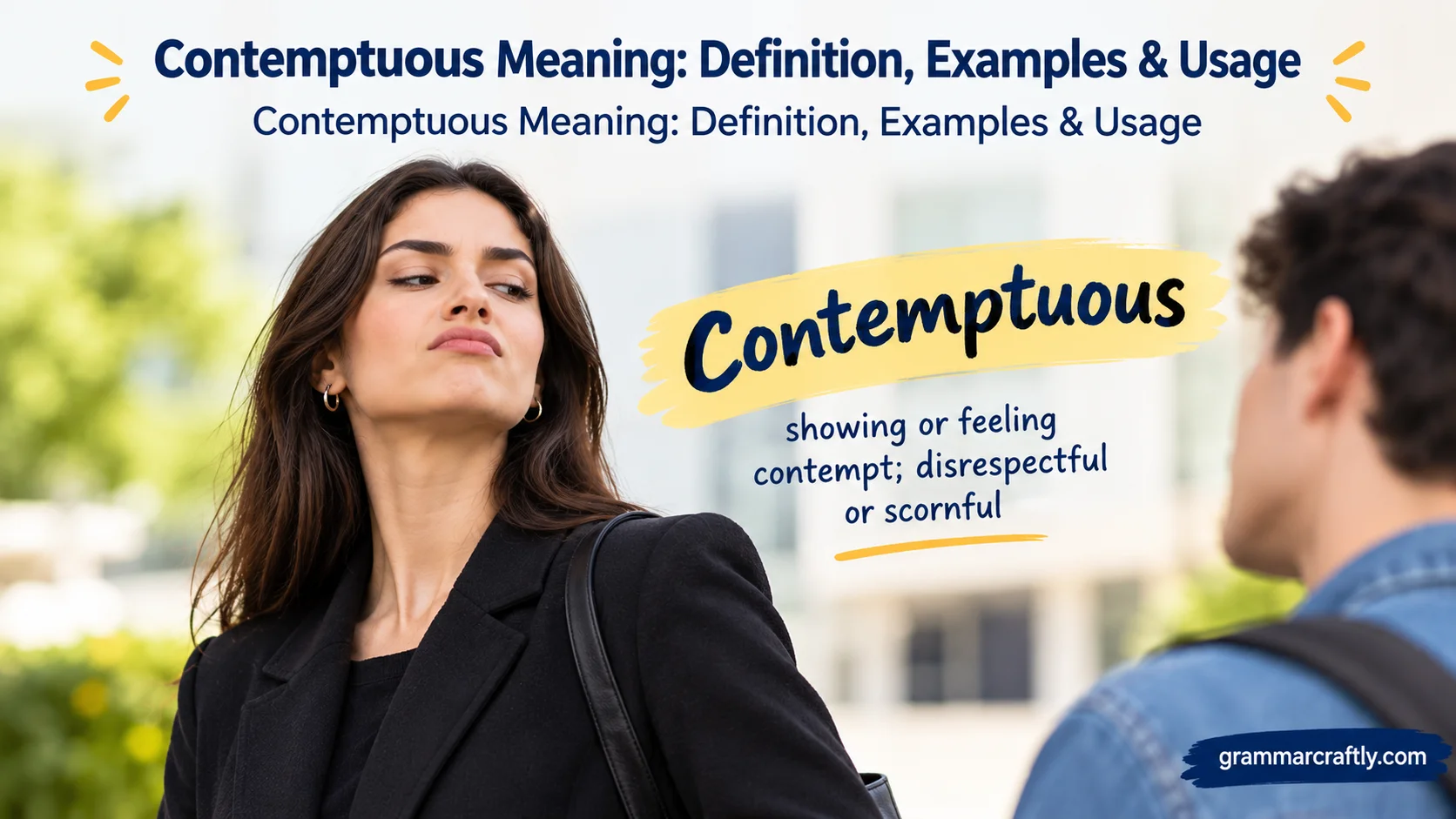
The contemptuous meaning describes an attitude, expression, or action that shows a strong lack of respect for someone or something. It often suggests that a person feels superior and considers another person, idea, or behavior unworthy of respect.
In everyday American English, the word usually describes tone, facial expressions, words, or behavior. For example, someone might give a contemptuous smile, make a contemptuous remark, or speak contemptuously about a coworker.
Unlike simple disagreement, contempt carries a stronger emotional message. It can suggest scorn, dismissal, superiority, or open disrespect. Cambridge defines contemptuous as expressing contempt, while Oxford describes it as feeling or showing that someone or something deserves no respect.
Quick Answer
The contemptuous meaning in American English is showing strong disrespect, scorn, or a feeling of superiority toward someone or something. It can appear through words, facial expressions, laughter, gestures, or tone.
TL;DR
- Contemptuous means showing strong disrespect or scorn.
- It often suggests that someone feels superior.
- A contemptuous look can communicate more than words.
- The word comes from the Latin idea of despising or scorn.
- It differs from ordinary disagreement or criticism.
- Today, it commonly describes hostile or dismissive behavior.
What Does Contemptuous Mean?
The word contemptuous is an adjective used to describe something that expresses contempt. In simple terms, it means showing that you don’t respect someone or something.
For example, if someone laughs at another person’s mistake with obvious superiority, that laugh may be contemptuous. Similarly, a person who speaks about others as if they’re worthless may sound contemptuous.
Simple Definition
A useful way to remember the word is:
Contemptuous = showing contempt, scorn, or deep disrespect.
The related noun contempt describes a strong feeling that someone or something has little value or deserves little respect.
Common Signs
A contemptuous attitude may appear through:
• A mocking or scornful laugh
• A dismissive facial expression
• An insulting or belittling tone
• A gesture showing superiority
• Words that treat others as inferior
What Does Contemptuous Mean in a Sentence?
The meaning becomes clearer when you see how the word works in real sentences. It normally describes the manner or attitude behind someone’s behavior.
For example, consider the sentence: She gave him a contemptuous look.
This doesn’t simply mean she looked at him. The adjective tells you that her expression communicated disrespect or scorn.
Everyday Examples
Here are several natural examples:
• He gave a contemptuous laugh after hearing the suggestion.
• She sounded contemptuous when discussing her former colleague.
• His contemptuous comments upset everyone in the room.
• The manager gave the proposal a contemptuous glance.
• They treated the new employee in a contemptuous way.
Why Context Matters
A person’s words alone don’t always prove contempt. Tone, facial expression, and the surrounding situation can change the meaning.
For example, saying “That’s interesting” could be sincere, sarcastic, dismissive, or contemptuous. The speaker’s delivery helps reveal the intended attitude.
Contemptuous vs. Contemptible
These two words look similar, but they don’t mean the same thing. This distinction is especially important for English learners.
Contemptuous describes the person, attitude, expression, or behavior showing contempt.
Contemptible describes someone or something deserving contempt. Cambridge defines contemptible as deserving contempt, while Oxford describes it as not deserving any respect.
Compare the Two
| Word | Basic Meaning | Example |
| Contemptuous | Showing contempt | He gave me a contemptuous look. |
| Contemptible | Deserving contempt | His behavior was contemptible. |
| Contempt | Strong lack of respect | She looked at him with contempt. |
| Contemptuously | In a contemptuous manner | He laughed contemptuously. |
The easiest trick is to remember -ous = showing or having the quality, while -ible often describes something that can receive that judgment.
Contemptuous vs. Disrespectful
Disrespectful is broader than contemptuous. A disrespectful action may simply fail to show proper respect.
For instance, interrupting someone can be disrespectful. However, interrupting them while clearly treating their opinion as worthless can be contemptuous.
The Main Difference
Contempt usually adds a stronger feeling of scorn or superiority.
A person can be disrespectful without feeling superior. A contemptuous person often communicates something closer to, “You’re beneath my respect.”
This is why contemptuous can sound much stronger than disrespectful in American English.
Contemptuous vs. Disdainful and Scornful
Several English words overlap with contemptuous. However, each carries a slightly different shade of meaning.
Disdainful often suggests looking down on someone or believing they aren’t worthy of attention. Oxford lists disdainful as a synonym of contemptuous and dismissive.
Scornful emphasizes open rejection, ridicule, or strong disrespect.
Quick Comparison
• Contemptuous: openly shows contempt or disrespect
• Disdainful: looks down on someone as unworthy
• Scornful: expresses strong ridicule or rejection
• Dismissive: treats something as unimportant
• Arrogant: behaves as though superior to others
These words can overlap, but they aren’t always interchangeable.
What Does a Contemptuous Look Mean?
A contemptuous look is a facial expression that communicates disrespect, dismissal, or superiority. It may involve a sneer, raised eyebrow, tight smile, eye roll, or other dismissive expression.
However, there isn’t one universal “contempt face.” Context matters.
Common Facial Signals
A contemptuous expression might include:
• A slight one-sided smile
• Raised or tightened facial muscles
• An exaggerated eye roll
• A dismissive stare
• A mocking or superior expression
In everyday American communication, these expressions can carry a powerful social message. Sometimes, the face communicates contempt before the person says anything.
Read More: Contemptuous Meaning: Definition, Examples & Usage
What Does a Contemptuous Tone Sound Like?
A contemptuous tone often sounds dismissive, mocking, sarcastic, or superior. The speaker may use ordinary words but deliver them in a way that reduces another person’s status.
For example, saying “Good job” can be supportive. Yet a sarcastic “Good job” after an obvious mistake can sound contemptuous.
Common Examples
Imagine someone says:
“You actually believe that?”
The sentence itself isn’t necessarily contemptuous. However, a mocking tone can turn it into an expression of contempt.
Similarly, phrases such as these may sound contemptuous depending on delivery:
• “Whatever you say.”
• “That’s adorable.”
• “You wouldn’t understand.”
• “Sure, if you say so.”
• “That’s your best idea?”
The context determines whether the speaker is joking, dismissive, sarcastic, or genuinely contemptuous.
What Is the Origin of Contemptuous?
The history of contemptuous reaches back to Latin. Oxford traces the word to Medieval Latin contemptuosus, from Latin contemptus, meaning contempt, and contemnere, meaning to despise.
The English adjective appeared around the 16th century. Etymonline records contemptuous in the sense of expressing contempt from the 1590s.
From Contempt to Contemptuous
The related noun contempt entered English much earlier. Its historical meaning involved disregard, disobedience, scorn, or treating something as unworthy.
Over time, the word developed broader everyday uses. Today, it can describe personal attitudes, social interactions, public criticism, and even formal language surrounding authority.
How Is Contemptuous Used in American English?
In the United States, contemptuous is common in formal and descriptive writing. People often use it when ordinary words such as rude or mean aren’t strong enough.
For example, an American writer might describe a politician’s tone, a character’s expression, or a workplace interaction as contemptuous.
Common American Contexts
| Context | Meaning in the USA | Common Association | Tone |
| Workplace | Looking down on coworkers | Superiority | Negative |
| Relationships | Treating a partner with scorn | Disrespect | Negative |
| Politics | Mocking opponents | Hostility | Strong |
| Literature | Showing a character’s attitude | Characterization | Descriptive |
| Everyday speech | Showing someone isn’t respected | Dismissal | Negative |
The word doesn’t belong to one particular American group or tradition. Instead, it describes a recognizable social attitude across many settings.
What Emotions Are Connected to Contemptuous Behavior?
Contempt often combines several emotions. It can include anger, disgust, irritation, superiority, or strong disapproval.
However, contempt isn’t simply the same as anger. Someone can be angry while still respecting the person they’re arguing with. Contempt often adds a judgment that the other person is beneath consideration.
Emotional Associations
• Superiority toward another person
• Disgust toward unwanted behavior
• Irritation with repeated mistakes
• Scorn toward an opposing viewpoint
• Cold dismissal of someone’s concerns
Because of this mix, contemptuous behavior can feel especially personal.
Is Contemptuous Always Negative?
Almost always, the word carries a negative meaning. It describes a lack of respect and often suggests that someone is being treated as inferior.
However, a writer can use it descriptively without personally approving the behavior. For example, a novel might describe a character as contemptuous to reveal that character’s personality.
Describing vs. Approving
Calling someone’s expression contemptuous doesn’t mean the writer agrees with it.
Instead, the word identifies the attitude being displayed. This distinction is useful in journalism, literature, essays, and everyday conversations.
How Is Contemptuous Used in Modern Culture?
Today, contemptuous behavior can appear in conversations, television, movies, social media, workplaces, and online arguments. Digital communication can make the tone harder to judge because readers can’t always hear a speaker’s voice.
A short message may therefore appear more contemptuous than intended.
Online Examples
Someone might interpret a reply as contemptuous when it contains:
• Mocking responses to another person’s opinion
• Sarcastic reactions to someone’s mistake
• Dismissive comments about personal interests
• Condescending replies during arguments
• Public ridicule of another person’s viewpoint
At the same time, online language often depends heavily on context. Humor, sarcasm, and friendly teasing can sometimes look harsher in writing.
What Is the Difference Between Contemptuous and Arrogant?
Arrogant describes an inflated sense of one’s own importance or abilities. Contemptuous focuses more directly on showing disrespect toward someone or something.
A person can be arrogant without actively showing contempt. Likewise, someone can behave contemptuously during a single argument without generally being arrogant.
Simple Example
Imagine a talented employee who constantly talks about their achievements. That person may be arrogant.
If they then laugh at a coworker’s idea because they believe it isn’t worth hearing, their behavior may also be contemptuous.
Therefore, arrogance can create an attitude of superiority, while contempt expresses that superiority toward a target.
Common Misunderstandings About Contemptuous
Because contemptuous overlaps with several negative words, people sometimes use it too broadly.
Not every disagreement is contemptuous. Not every criticism is contemptuous either.
What It Does Not Automatically Mean
• Disagreeing with another person’s opinion
• Saying that an idea has problems
• Giving honest negative feedback
• Having a different political position
• Refusing to accept someone’s argument
The key feature is disrespect or scorn. Without that element, another word may be more accurate.
Why Does Contemptuous Sound So Strong?
The word sounds strong because contempt is more than simple dislike. It suggests that the target has little value or deserves little respect.
Oxford’s definition of contempt centers on viewing someone or something as lacking value and deserving no respect.
The Social Message
A contemptuous response can communicate several ideas at once:
“I don’t respect you.”
“I don’t take your opinion seriously.”
“I believe I’m above you.”
That is why the word often appears in descriptions of tense relationships or heated conflicts.
Contemptuous Synonyms and Related Words
Choosing the right synonym depends on the exact situation. Some alternatives emphasize disrespect, while others emphasize superiority or ridicule.
Useful Alternatives
• Scornful — openly showing strong disrespect
• Disdainful — treating someone as unworthy
• Disrespectful — failing to show proper respect
• Dismissive — treating something as unimportant
• Condescending — speaking as though superior
• Derisive — expressing ridicule or mockery
• Supercilious — behaving with an unpleasant sense of superiority
These words are related, but none is perfect in every sentence. Contemptuous is especially useful when strong disrespect is central to the meaning.
FAQs
What is the simple meaning of contemptuous?
Contemptuous means showing strong disrespect, scorn, or a feeling of superiority. It describes an attitude, expression, tone, or behavior.
Is contemptuous a negative word?
Yes. The word normally carries a clearly negative meaning because it involves disrespect or scorn.
What is an example of contemptuous behavior?
A person laughing at someone while clearly treating them as inferior could be behaving contemptuously. A mocking or dismissive expression can also communicate contempt.
Is contemptuous the same as disrespectful?
Not exactly. Disrespectful is broader, while contemptuous usually suggests stronger scorn or a sense of superiority.
What is the difference between contemptuous and contemptible?
Contemptuous means showing contempt. Contemptible means deserving contempt.
Is contemptuous the same as arrogant?
No. Arrogance involves an inflated sense of superiority, while contemptuous behavior actively communicates disrespect toward someone or something.
Conclusion
The contemptuous meaning centers on strong disrespect, scorn, and the feeling that someone or something isn’t worthy of respect. In American English, it commonly describes a person’s tone, facial expression, words, or behavior.
The word is stronger than simply saying someone is rude or disagreeable. It points toward a deeper attitude of dismissal or superiority. Once you understand that difference, words such as disdainful, scornful, dismissive, and condescending become easier to distinguish.